
While ultra cyclist James Macdonald attempts to break a world record on the oval track at London’s Olympic Velodrome, a coach feeds him times and speeds in his ear based on object recognition AI.
TechInformed is on hand to watch Macdonald attempt to break the indoor cycling 100-mile world record of 3 hours, 46 minutes and 16 seconds.
Although his efforts will ultimately be in vain this time, Macdonald’s coach is using artificial intelligence data provided by digital consultancy Appsbroker, and Google AI. In his day job, Macdonald works as a customer engineer for the search engine giant.
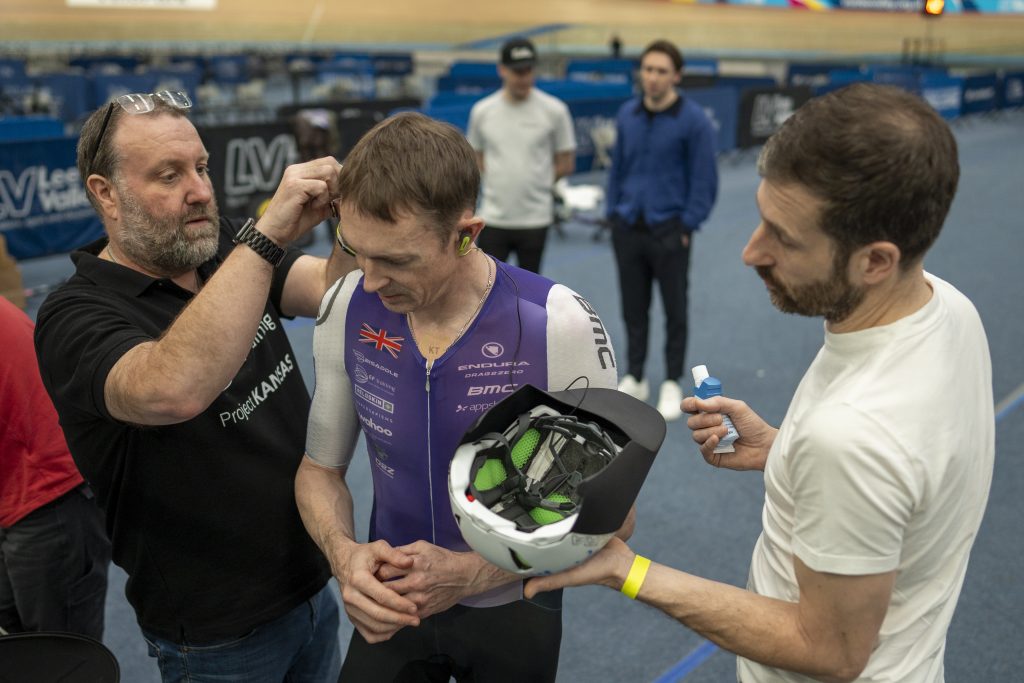
Ultra cyclist James Macdonald
Macdonald had previously attempted to break 13 different Guinness World Records at once as part of a 24-hour cycling challenge, but he had problems with timing.
“As a customer engineer, we’ve worked with James on different projects, and he mentioned he had this problem with timing and information,” says Matt Penton, head of data and analytics at Appsbroker. “We said, well, we like doing cool stuff; give us the challenge.”
Penton adds that measuring a Guinness World Record requires a secondary timing system. To help Macdonald, digital consultancy Appsbroker created three timing systems, one of which uses video object recognition AI and the others using laser lines.
These operate alongside an underfloor timer built into the Velodrome.
While the laser lines acknowledge an object has passed through them, the object recognition AI tool is built to recognise what a cyclist would look like zipping past. Then, it’s sent to the cloud, and those on the floor, such as his performance coach, can see the information on a dynamic dashboard in real-time.
“It’s changed the way his performance coach, Toby, has the information. He can tell him immediately what his average is, and James can ride to a certain KPH and consistently ride to that speed,” explains Penton. “He gets told the number, and he does the number.”
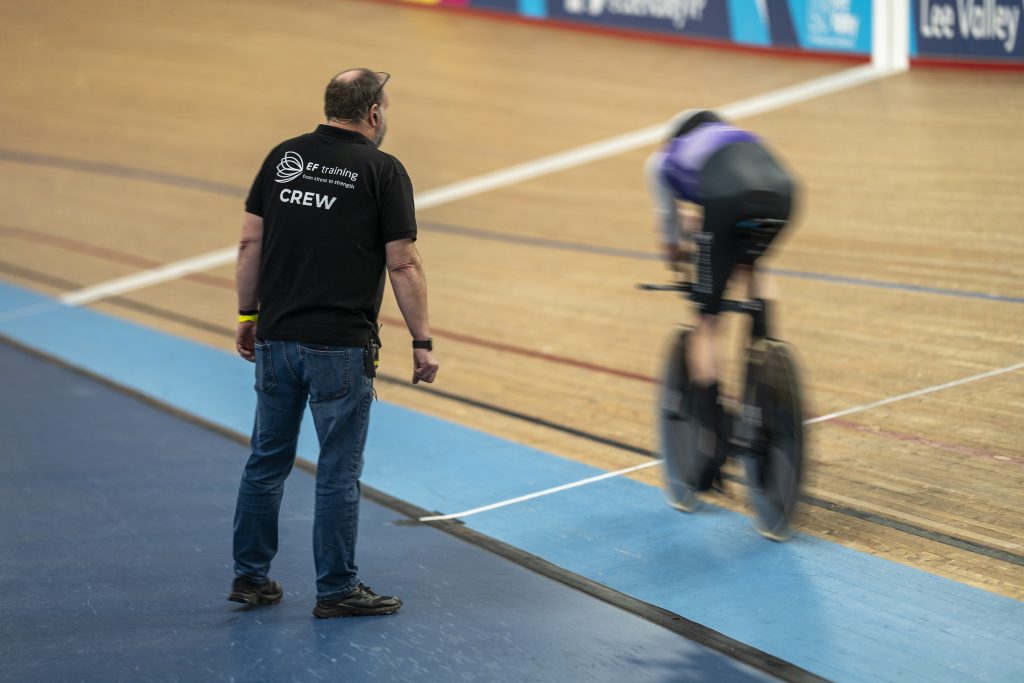
Macdonald’s performance coach is able to relay the AI data through an inner ear piece
Using video recognition technology in enterprise
Appsbroker CTS is a UK-based digital consultancy with customers ranging from retailers such as John Lewis to automotive firms like Jaguar Land Rover and others in banks, telecoms, sports, and more.
The company was formed following a 2023 merger between Appsbroker and CTS to form what it claims is the largest Google Cloud-Only partner in Europe.
According to his LinkedIn, Penton has been with the business since 2017. He believes object recognition AI can help industries across the board.
Last year, Appsbroker worked with the Environmental Services Association (ESA), the trade body representing the UK’s resource and waste management industry, to recognise e-scooters that had been wrongly disposed of into waste management, creating a fire risk.
As of recent, e-scooters and their lithium-ion batteries have proven to be a significant fire safety hazard.
A recent investigation found that an e-scooter’s battery or charging unit was the cause of a fire in a London home last year, while another e-scooter spontaneously burst into flames in a London flat due to a failure of its lithium battery pack.
With this risk, any lithium-ion batteries from scooters that make it to waste recycling centres need to be tracked to avoid costly and grave risks.
“We trained up video [CCTV] models to recognise when somebody’s carrying what looks to be an e-scooter and do an immediate intervention to stop it,” says Penton.
Using Appsbroker’s model, waste management firms were able to detect the e-scooters with an accuracy of nearly 70% – helping to prevent any fire incidents from lithium-ion batteries. The technology can be applied beyond e-scooters to objects, including power tools and e-bicycles.
This type of video recognition can be expanded to manufacturing facilities packed with legacy machinery, he adds.
“With old manufacturing, if there’s a problem with the machine, you may expect there to be data coming off of it. No, it’s just lights,” explains Penton.
Red light, green light
While hip new data-powered technology may be costly to add, implementing AI-powered video feeds that recognise when a light turns red could be the answer.
“So, a video feed in those areas looks for warning lights, which they are trained to recognise, and then alerts somebody to fix them.”
This not only saves costs but also saves an employee the admin time of checking the machines every 10 minutes, which could be spent doing something else.
With this, rail inspections are another time-consuming manual task that, according to Penton, is “crying out for a solution.”
At the moment, trains are sent along the rails to film footage of the tracks, then someone goes through the footage and keeps an eye out for any faults from sight.
An AI model trained to recognise railway faults can run through the footage itself and highlight any faults on the track in a fraction of the time.
“Pretrained models are way more sophisticated than they used to be,” says Penton.
Separately, robotics firm Energy Robotics uses camera-mounted automated drones, robodogs, and more to relieve the burden on those in the sector making inspections in hazardous places such as oil rigs or remote areas on faulty machinery or can even recognise a broken barrier.
Nowadays, there are hundreds of thousands of images to train an AI to detect. Even generative AI can prove itself beneficial as it can produce an image of an e-scooter, a red light on a machine, or even an image of a brain tumour CT scan for the purpose of video or photodetection.
“We can fill in missing data now, and it’s a much-maligned part of GenAI,” says Penton. However, it can be used in incidents with insufficient data and speed up the training of potentially life-saving AI.
Object recognition AI models could be extremely important for the detection of brain tumours, however, building them is taking time.
“Thankfully, by definition, brain tumour CT scans are incredibly rare,” says Penton, but they are needed to build the AI.
To save time, “GenAI is very good at generating stuff and then giving us synthesised CT scans to allow us to train a model to make it more productive,” says Penton.