

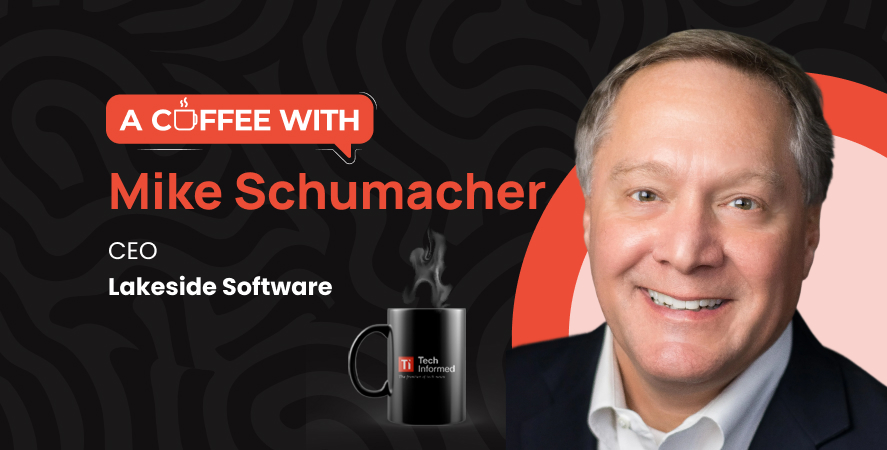
Lakeside Software CEO Michael Schumacher on the AI advantage hiding in 27 years of IT data
Lakeside Software’s returning CEO explains why decades of endpoint data have become the company’s biggest AI asset — and how the shift from visualization to reasoning is rewriting what IT teams can do
What happens when you point AI at 27 years of IT data? That’s what Michael Schumacher is keen to find out after returning as CEO of the company he founded in 1997.
Schumacher stepped aside from the CEO role in 2021 and returned in April 2025 with a renewed focus on AI. In the intervening years, he immersed himself in machine learning research — and came back convinced that the company’s vast endpoint telemetry could power a fundamentally different kind of IT tool.
Over a coffee, Schumacher reflects on Lakeside Software’s evolution, the opportunities created by AI and why building great teams remains the foundation of everything.
Tell us about your career leading up to your current role.
I founded Lakeside in 1997. I’m a software engineer by trade; they don’t let me build software anymore, but I still love the innovation side of the business. I’m very involved in product strategy, direction and big ideas, but we now have engineers who are stronger than me and actually do the building. In the early days, I built the first versions myself.
Lakeside has gone through three different phases, like three companies under one roof. The first phase built tools to manage Citrix terminal server environments — helping organizations optimize shared infrastructure. The second phase focused on understanding employee behaviors and how IT can meet their needs: tools, equipment and how to support them properly. The third phase is what led to our digital employee experience (DEX) tools.
We were a bootstrapped company for many years, up until 2020, when we partnered with Insight Partners. They helped us take the company to the next level, especially on the go-to-market side, treating growth as a science in the same way we treat product and technology.
In 2021, I stepped out of the CEO role after many years and stayed on as a board member, writing strategy papers and thinking about direction. It gave me space to breathe after years of 80–90 hour weeks. I spent time learning, taking courses, reading research papers and really understanding AI and machine learning. It’s fascinating, but it took time to properly get my head around it.
In April 2025, I came back as CEO. The reason was the opportunity AI creates, especially given our data advantage. It allows us to deliver value to customers on a completely new scale. What Lakeside needed at that time was an innovative, almost startup-like energy to lead that charge — and that’s what I’ve been doing.
It feels like perfect timing: stepping away and coming back with all that new knowledge, especially with AI taking off.
I had time to step back, look at the business as a whole, learn new things and then come back and realize how much I genuinely love doing this. It’s an exciting time. In my opinion, there has never been more opportunity for innovation and entrepreneurship than there is right now.
How has AI changed things?
It’s been astounding. It took time for me to understand it properly, but the potential is incredible. Our biggest advantage has always been data — huge volumes of it. Humans struggle to make sense of that scale, but AI is hungry for data. For the first time, we can extract real value from decades of accumulated data.
I often say: in the AI world, data isn’t fuel — it’s diamonds. Combine that with reasoning models and it’s incredible what becomes possible.
Our focus now is amplifying expertise: helping skilled people do more, automating the less valuable parts of their work and increasing impact. Things that were impossible two or three years ago are now real.
How do you personally use AI?
All the time. For writing, thinking, structuring ideas, research, communication. It’s changed how I work. I try to be AI-first — using it to amplify my own expertise and get more done. And things change so fast; something that didn’t work six months ago might work perfectly today.
How do you switch off?
I enjoy time with my wife and family, being outdoors, walking the dog, being in nature. You never fully switch off, but you can switch off enough to relax. And I’m lucky to work with people who handle problems without me.
What’s coming next for Lakeside?
We’re rethinking how software works — moving from data visualization to reasoning and automation. We’ve introduced tools that can automatically diagnose PC problems in seconds — things that used to take skilled technicians hours.
2026 will be even more exciting than 2025. We’re rewriting what IT teams can get done in a day, a week, a month — and making life better for the people who depend on them.
How do you take your coffee?
Americano. Straight, black.