
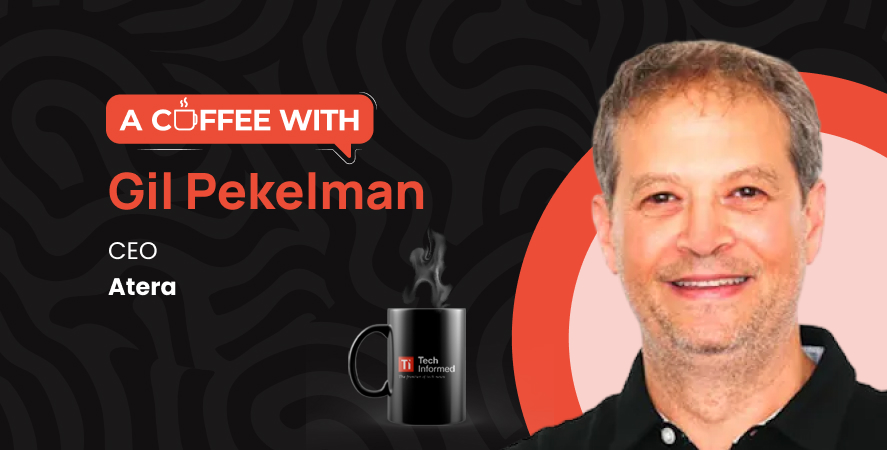
Atera’s Gil Pekelman on building IT that fixes itself
Atera’s CEO on building AI for IT support before ChatGPT existed — and why the goal was always ‘peace and quiet’
The insight that set everything in motion was deceptively simple.
When small businesses evaluated Atera’s cybersecurity tools, they kept asking the same question: “Will it bring us peace and quiet?”
In this interview, edited for length and clarity, Atera CEO and Cofounder Gil Pekelman discusses why IT teams have been stuck in reactive mode for decades, how Atera built its AI capabilities years before the generative AI boom and what it means to run an AI-native company today.
Can you talk about your career journey up to where you are now?
I’ve been in tech all my life. I was bitten by the tech bug right after university and never got rid of it. I started as an application engineer — my first-ever job in tech. My path went from digital printing into storage and later into cybersecurity, and then developed into Atera today.
I’m one of two founders; I have a cofounder for Atera. We founded the company seeing a really strong need for what we’re doing. We’re a million-dollar company today, and it’s been an amazing journey.
Tech companies are always cutting-edge. To this day, a new version of software gets me excited.
What prompted you to launch the company?
From the cybersecurity days, we were working with small and medium businesses. They would say, “Your product is amazing technology,” but then ask, “Will it bring us peace and quiet?”
We realized there was no intuitive, sophisticated IT management platform when we launched Atera’s first IT-specific product in 2016. We built something super intuitive — an IT person can be up and running in five minutes — and unified everything into one platform instead of multiple complicated tools.
That one sentence — “Will it bring us peace and quiet?” — showed us there was a huge market where a product didn’t exist. IT people were always reactive. We made them proactive. The core of our product is identifying problems before they happen.
How has Atera evolved since then?
Since 2017, we started developing an AI system that sits in the middle — understanding the problem, understanding how IT professionals fix it and fixing it automatically.
We launched our AI platform in May 2025. It can handle about 90% of IT tickets end-to-end. If someone says, “My computer is slow,” it diagnoses the device, the network, the internet, the software, understands the cause and fixes it.
You’re listed on three patents. Is there one you’re most proud of?
The big patent developer is my cofounder. The one I’m most proud of is the core AI infrastructure. It’s mind-boggling.
Think about IT today — you open a ticket, wait hours, someone connects remotely. Here, with AI, you have your own personal IT person. Any problem, any question, it fixes it for you. It never gets tired, never sleeps.
What stands out from the last few years at Atera?
In 2022, when we first saw it truly work, someone could write to the AI, “My computer is slow,” and the system understands, creates code and executes a solution. It felt like alien technology.
How do you use AI in everyday life and across the company?
Personally, for research, reports, presentations, strategy.
At Atera, we’re AI-native with about 60 AI projects across HR, legal, finance, R&D, product, customer support and customer success.
For example, shift scheduling: one person used to spend three days a month doing it. We built an AI app that generates schedules in seconds. That saves 36 days a year of work for one senior manager.
We have about 20 internal AI applications like that.
How do you take your coffee?
Americano, with a little bit of frothed milk on the side.