

DoiT’s Amit Kinha: FinOps needs a new ROI language for AI
DoiT’s field CTO on cloud cost management, enterprise AI ROI and why ‘everyone’s more productive’ is no longer a sufficient return on investment
When Amit Kinha reflects on the cost of cloud computing, he tends to ask a question that makes finance teams uncomfortable: what is this actually buying you?
It’s a question he spent years asking from the practitioner’s seat — first as a software engineer at Goldman Sachs on the Apple Card and Marcus, then as Citigroup’s director of cloud FinOps — and one he now brings to the vendor side.
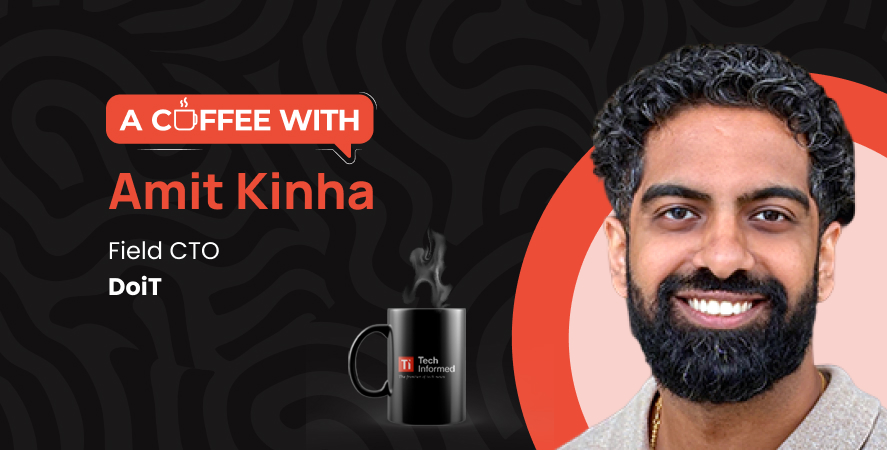
Nine months into his role as field CTO at DoiT, a cloud financial management platform, Kinha sat down for coffee with TechInformed to discuss how AI is forcing FinOps to grow up, and why dashboards alone will no longer be enough.
What led you to your current role at DoiT?
Before DoiT, I was a director at Citigroup running FinOps globally. The role I’m in now feels like the perfect blend of my background. Engineering, product, a bit of sales, but ultimately it’s about communication and storytelling.
Earlier in my career I was at Goldman Sachs, working as one of the lead engineers on Apple Card. When I joined Citigroup, I wanted to stay close to engineering but work on something that directly impacted the bottom line. FinOps felt like the natural fit because every decision we made directly impacted the bottom line.
What has moving to the vendor side been like?
This is my first role on the vendor side. Previously, I was the buyer of SaaS platforms. There’s been a lot of learning around what it actually means to sell a product.
In enterprise environments, you’re not just selling software — you’re selling trust. Trust that instead of building everything in-house, a company can rely on you to solve meaningful problems.
Having run a FinOps practice myself helps. I’ve been in the customer’s seat. Combined with public speaking and industry engagement, it’s become a natural extension of my career.
You began your role as field CTO at DoiT in June 2025. What have you learned?
Enterprise sales cycles are much slower than I appreciated. From discovery to contract can take six to ten months. Finding the right stakeholders, aligning priorities, differentiating in a crowded market, it all takes time.
The other big adjustment has been scale. Citigroup had around 240,000 employees; DoiT has around 600. That means speed. If we identify an acquisition target, it’s not a two-year exercise. We can move in months.
There’s also more agency. If we want to build something, there’s no cavalry coming; we are the cavalry. I can influence product vision, sales enablement, even product marketing. That ambiguity is exciting but challenging. There isn’t always a clear right or wrong answer. It’s about defining a vision, testing it quickly and scaling what works.
What are the biggest challenges facing FinOps today?
At its core, FinOps is governance around cloud cost. When organizations move from on-premises data centers to the cloud, they’re effectively giving every engineer a credit card. The same web application can be built in a thousand ways — some cheap, some highly resilient and globally distributed.
Most companies are stuck at visibility. They have dashboards and spend reports, but that’s reactionary. It’s like checking your personal banking app after the money’s gone.
The real question isn’t just what you’re spending; it’s what you’re getting in return.
People assume FinOps is about saving money. I see it as building confidence to spend more intelligently.
With AI entering the picture, this becomes critical. If you’re exposing LLMs to customers, you need confidence you won’t bankrupt the business. Alerts shouldn’t just flag spend; they should connect to revenue targets, customer tiers and business outcomes.
Have you taken risks that shaped your career?
I’ve never stayed on the same team or product for more than about two years. At Goldman Sachs I moved from derivatives to Marcus to Apple Card. At Citigroup I shifted from engineering into leading FinOps globally.
That movement wasn’t necessarily about getting bored but wanting a new challenge and to learn something new.
The bigger risk was stepping off the traditional engineering path. The default trajectory is individual contributor to engineering manager to VP of engineering and maybe CTO. But engineering fundamentals are transferable.
When I moved to DoiT I initially had some hesitancy. I’d always been a practitioner, but I’d never worked directly in product marketing or enterprise sales. It felt like a calculated risk, and growth requires that.
What does the industry need to prepare for with AI?
AI has evolved rapidly. In 2022, people said it wasn’t good enough. By 2026, we’re talking about agents writing code and running workflows.
The issue isn’t capability. It’s ROI. Boards want an AI narrative, but executives struggle to quantify returns. How do you measure productivity gains for a journalist or a copywriter? It’s not as simple as story points.
The experimental phase is ending. Now CFOs are asking: if we spend $50 million a year on AI tools, what are we getting back?
FinOps will need to integrate value metrics, not just cost tracking. “Everyone’s more productive” isn’t sufficient. We need measurable outcomes.
How do you personally use AI?
I’ll go on long walks and use voice mode in ChatGPT as a thinking partner. I’ll explain a half-formed thesis and ask what I’m missing or where the counterarguments are. It’s the world’s most patient collaborator.
If you simply ask AI to build something without direction, you get generic output. But if you iterate with your own ideas, it accelerates thinking.
Final thoughts?
Three themes have shaped my career: risk-taking, composability of experience and building systems that outlast you.
With AI accelerating change, adaptability may be the most underrated skill engineers possess. The future belongs to those who can learn, connect disciplines and define value — not just track cost.