
Building the blueprint for an AI-native telecoms future
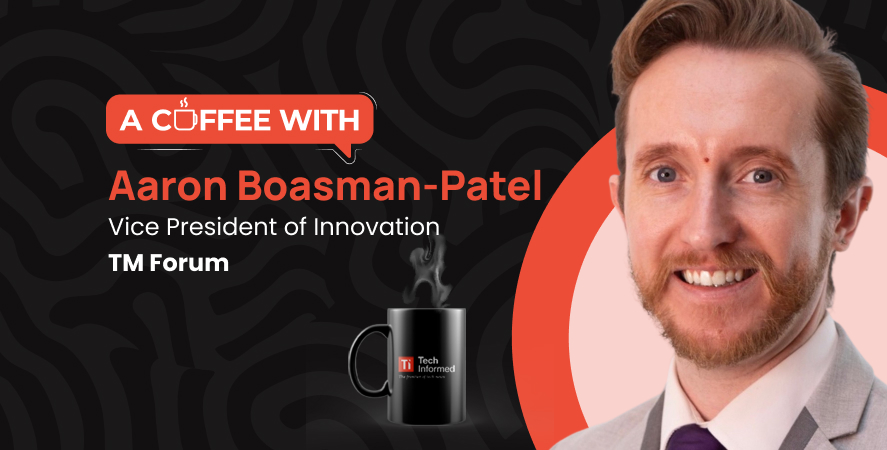
Aaron Boasman-Patel, VP of innovation at TM Forum, on getting competitors to collaborate, why AI-washing is rife and what the Victorian era has to do with satellite networks
Aaron Boasman-Patel started his career researching CDMA at a time when no one quite knew which wireless technology would win.
Nearly two decades later, he’s running TM Forum’s global innovation program and the questions haven’t got any simpler.
TM Forum is the global industry association that sets the architectural standards and runs the collaboration programs that keep the world’s largest telecom operators — and the vendors that serve them — moving in roughly the same direction. With more than 800 member companies, it sits at an unusual intersection: part standards body, part innovation lab, part referee for an industry that is simultaneously competing and interdependent.
When the telecoms industry needs to agree on how AI agents should talk to each other, or how a satellite network integrates with a terrestrial carrier’s billing system, TM Forum is often in the room.
We caught up with him over a builder’s tea.
What was your career like up until becoming the vice president of innovation?
I started at Informa Telecoms and Media. I joined as a graduate from university, working in conferences as a researcher.
In those days, you’d be assigned certain areas and that was a really good grounding for understanding the whole telecoms landscape. Even though you specialized in certain areas, they were still quite broad.
Believe it or not, the first ever telecoms topic I researched was CDMA, which was really a Qualcomm technology that all the U.S. phones were based on. At the time there were competing technologies — LTE and WiMAX — all competing for this new kind of 4G high-speed internet.
CDMA eventually fell out of favor. WiMAX was a frontrunner for a while until Ericsson pulled out and the market moved away from it. LTE was the eventual winner.
It was a great foundation for understanding how innovation starts, how you can have competing technologies and how technical resilience and brilliance ultimately win out. It was about understanding things like spectral efficiency, reducing power consumption at base stations, getting scale in the terminal market, and how devices could be produced more cheaply.
When I joined telecoms, the industry had just gone through the big crash, so it was all about rebuilding — looking at technologies with much greater cost consciousness while still innovating.
From the conferences side, I began writing articles and getting more involved in the analyst side. Eventually I moved to TM Forum, where I’ve been for nearly 14 years now.
How did that transfer into your current role?
I’ve had a varied career here. I started in events, then ran the research and media business, and then moved into broader content leadership. I was also one of the early founders of our AI and autonomous networks practice.
Now I run the innovation business, our Catalyst program, where we run about 72 proof-of-concepts every year. The industry comes together to innovate, competitors collaborate, and we develop new solutions. We’ve also set up our innovation hub in Mumbai.
What are the highest priorities for you this year at the Innovation Hub?
Over the past two years, we’ve built what we call the ODA [Open Digital Architecture] Canvas, which is essentially the blueprint operating environment where all the components and APIs work together to create end-to-end solutions.
Now the challenge is to make that truly AI-native.
AI is everywhere and people need to understand how components how they work together, who manages the agents, who manages workflows, and how agent-to-agent interactions function.
We’re also defining patterns for how AI agents should be built, because standardization creates economies of scale. Agents should ideally be built in consistent ways so they integrate smoothly.
If there’s a network fault, AI should be able to detect it, diagnose it, and ideally trigger self-healing. That’s what we refer to as Level 4 autonomous networks. If it can’t self-heal, it should pinpoint the exact fault so an engineer can fix it.
And that extends all the way to the OSS/BSS [Operations and Business Support Systems] layer: customer relations, billing, and service management. Linking all of that together is hugely important for the industry.
You also run the innovation lab with different companies. How do you get them to collaborate?
Everyone understands that each company brings something unique to the table.
Our Catalyst programme is very much plug-and-play innovation. Companies come together around a specific challenge, usually sponsored by service providers who say, “This is a problem no one has solved yet.”
The industry has moved away from monolithic, single-vendor systems. Everything now is multi-vendor.
Companies want to understand where they fit into the ecosystem. We’re also seeing lots of smaller players with specialized capabilities, which is why we see so much M&A activity.
Take Project Foundation as an example. You might have AWS providing the cloud platform, Databricks working on data processing, MuleSoft or Salesforce focusing on customer integration, and others contributing different elements.
Competitors sometimes collaborate as well, because each brings different capabilities.
That’s what’s so exciting about innovation at TM Forum. We bring the entire industry together.
For the run-up to DTW [Digital Transformation World, TM Forum’s annual conference] we’ll have over 1,200 people collaborating to build industry-led solutions. That’s something very few organizations can claim.
Participants come from all over the world — China, Canada, South Africa, Argentina, Cambodia, Australia, the Middle East, everywhere.
One of the biggest developments in recent years has been the involvement of satellite companies, like Airbus. That’s where we start to see non-terrestrial and terrestrial networks coming together to deliver better connectivity globally.
Tell me more about how satellite companies fit in.
Traditionally it’s been difficult to integrate satellite networks with terrestrial telecom networks. In the past you’d think of satellite mainly for remote communities — a dish on a roof, large equipment.
Now we’re looking at how satellite can integrate with telecom operators to provide additional capacity. Think about stadium events where you need temporary extra capacity, or remote areas where terrestrial networks are limited.
We’re also seeing it on aircraft. When I was recently flying back from Asia, I had Wi-Fi on the plane likely powered by satellite.
A whole new ecosystem is developing between satellite providers and telecom operators.
We’re moving towards a fully connected world.
I often compare this period with the Victorian era. In a few decades society went from horse-drawn carriages to electricity and telephones.
Today the change is just as dramatic, but it happens gradually so we barely notice it.
How are projects addressing connectivity gaps in developing regions?
Every country has different challenges.
In many parts of Africa, for example, power is the biggest issue. Some base stations still run on diesel generators and sometimes that diesel gets stolen.
So efficiency becomes critical. If networks can use spectrum more efficiently and reduce power consumption, you need fewer base stations.
We’ve also done a lot of work on sustainability and self-healing networks.
Last year we ran a hackathon focused on natural disaster resilience and how networks can recover after earthquakes or tsunamis.
Connectivity is no longer optional — it’s essential. It affects education, healthcare, and economic opportunity.
We’ve even explored telemedicine, where doctors can support remote communities through connected services.
Many AI projects never make it beyond the pilot stage. Where do you see the most success?
There’s definitely a lot of “AI-washing.”
People label things as AI even when they aren’t truly transformative.
My role is to experiment and explore what AI can realistically do.
The biggest successes come when AI supports humans rather than replacing them.
Telecom networks are highly regulated, and some tasks will always require human oversight.
Where AI works best is in efficiency, removing repetitive tasks so engineers can focus on more complex work.
For example, autonomous networks can automate many operational processes.
But successful AI adoption also requires buy-in across the organization, from the C-suite to engineers on the ground. Without that, people simply won’t use the tools.
How do you personally use AI in your daily work?
We use AI across many areas.
For example, when designing telecom architectures, we can upload existing design patterns into AI tools. They can then suggest APIs, components, and potential integration issues.
AI might get us 70% of the way there, saving weeks of work, while humans focus on the complex design decisions.
We also use AI for designing APIs, frameworks, and documentation.
And on the marketing side, AI helps summarize documents or prepare communications.
So AI really touches everything, from technical architecture design to marketing.
You also work with The King’s Trust. Could you tell me about that?
I mentor young adults from disadvantaged backgrounds who want to get into tech or business. Sometimes they’ve had health issues or difficult home situations that interrupted their education.
The program helps them build skills, prepare for interviews, and enter the workforce.
It’s incredibly rewarding. Many young people just need someone to believe in them.
I actually studied history, not technology. But I’ve worked in tech for nearly 20 years now. That shows that anyone can move into this field if they have the opportunity.
Technology, especially AI, is becoming more accessible, and I strongly believe in democratizing access to opportunity.