
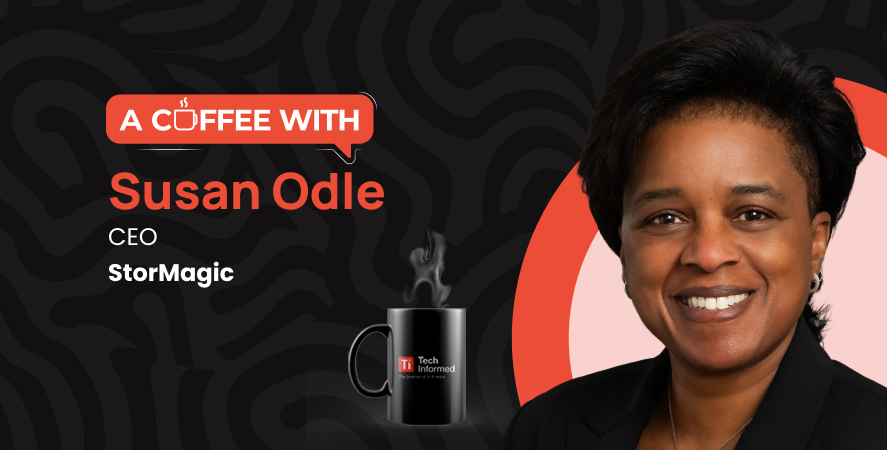
CEO Susan Odle on three decades of doing the homework
StorMagic's CEO on why curiosity is a superpower and how doing the homework cuts through the bias she says still exists
Susan Odle came up through commission-only sales in the early 1990s with a keen curiosity about the ins and outs of every side of business.
Nearly three decades later, after channel-strategy roles, a COO seat she took amid the global pandemic and a stint in private equity, she runs an edge IT infrastructure company at a moment when its core market is being reshaped.
Odle was appointed CEO of IT infrastructure firm StorMagic in April 2025, eight months after joining the Bristol-based hyperconverged infrastructure firm as chief growth officer. She’s also one of a small number of women — and a smaller number of women of color — running an enterprise IT firm. We sat down with her to talk about everything from the route up to what her customers are wrestling with right now.
Walk us through your career path up until now.
I’ve been in tech for over 30 years. Most CEOs tend to come from either a sales or engineering background; I came up through sales.
I started as a commission-only salesperson working with OCR (optical character recognition) and fax-based reporting systems. I didn’t have a technical background or academic qualifications in the field, but two engineers who had started a company gave me a chance.
From there, I moved into other sales roles, eventually specializing in channel development. I spent years building and growing channel teams, including being part of a company that was acquired by Quest Software.
Later, I spent about a decade advising CEOs and sales leaders on how to scale through channel strategies. After that, I deliberately moved into operations because I wanted to understand the back-office side of the business. That led to a COO role at BDO Lixar, a technical services company, where I managed both technical and go-to-market teams.
After that, I worked in private equity before joining StorMagic as chief growth officer, and now CEO.
What is the proudest moment in your career?
It was during my time at Lixar, leading a 200-person team specializing in AI and application development. The company was acquired by BDO Canada just before COVID.
As you can imagine, the acquisition hadn’t accounted for a global pandemic. I joined as COO to help the company meet its earnout targets during an incredibly difficult period.
We completely reworked the delivery model. One of the key exercises we did was to “trace the dollar” through the business, from lead generation all the way to delivery and post-delivery. That helped us identify inefficiencies and unlock value quickly.
We then reorganized the team to improve how solutions were delivered. Despite the circumstances, we increased both profitability and bookings, all remotely during COVID.
What made it especially meaningful was the impact. It wasn’t just about the business, but the employees and their families. That experience really cemented my expertise in transformation and change management.
It sounds like curiosity played a big role in your journey. Is that fair?
Yes, curiosity is a superpower.
I’m naturally wired that way; I always ask “why.” If someone tells me we need to do something, I want to understand the rationale behind it.
For those who aren’t naturally curious, I’d encourage them to consciously build that habit and keep asking “why.” It helps you learn faster and make better decisions.
Any advice for anyone looking to reach the board?
Career growth takes time. Nothing meaningful happens overnight.
If you’re ambitious, stay focused, work hard, use data and play the long game — you might be surprised where you end up.
What challenges have you had to overcome in your career?
On a personal level, I’m a woman and a visible minority, and bias does exist. That means I’ve often had to do more to prove myself.
You can choose to step back because of that, or you can push forward. I chose the latter.
One key lesson I’d share, especially with other women, is to be prepared. Do the homework, build your case and use data. When you present a well-supported argument, it’s much harder for people to dismiss it.
Even if the answer is still “no,” you earn respect for the way you approach it.
What benefits have you seen from having a diverse leadership team?
Diversity at the board and executive level is critical. There’s no single “right” perspective. The more diverse your team, the broader your thinking.
For example at StorMagic, our board is evenly split between men and women, with a mix of backgrounds, finance, technical, sales and geographies. That leads to richer, more robust discussions.
I’d also highlight the importance of relationships and mentorship. My first mentor, Deborah Rosati, now runs an organization called Women Get On Board, which supports women entering board roles. Relationships like that can last decades and be incredibly valuable.
What challenges are your customers facing right now?
There are a few major factors. Hardware costs and supply chain issues are a huge challenge, and that’s not likely to improve in the near term.
At the same time, organizations are rethinking their infrastructure strategies, particularly around virtualization and edge computing.
How is AI changing things?
It’s changing everything but it’s still early days.
The key question isn’t just how to use AI, but where it fits, what workloads make sense, what can be operationalized and what remains experimental.
Our role isn’t to compete with AI platforms, but to ensure our infrastructure can support AI workloads effectively.
Right now, there’s a lot of uncertainty. Organizations are balancing AI, containers, virtual machines and cloud strategies — all while dealing with hardware constraints. It’s a very complex landscape.
It sounds like companies are focusing more on short-term decisions than long-term planning.
The pace of technological change is so fast that long-term predictions are increasingly difficult.
Many organizations are breaking strategies into shorter phases, optimizing what they can now while keeping options open for the future.
The key is flexibility and choosing the right partners so you don’t get locked into the wrong decisions.
How do you take your coffee?
I’d go with an Italian stovetop espresso — there’s no better way to make coffee. I use espresso beans and actually have two stovetop pots, a small and a large one, depending on how many people I’m serving.