
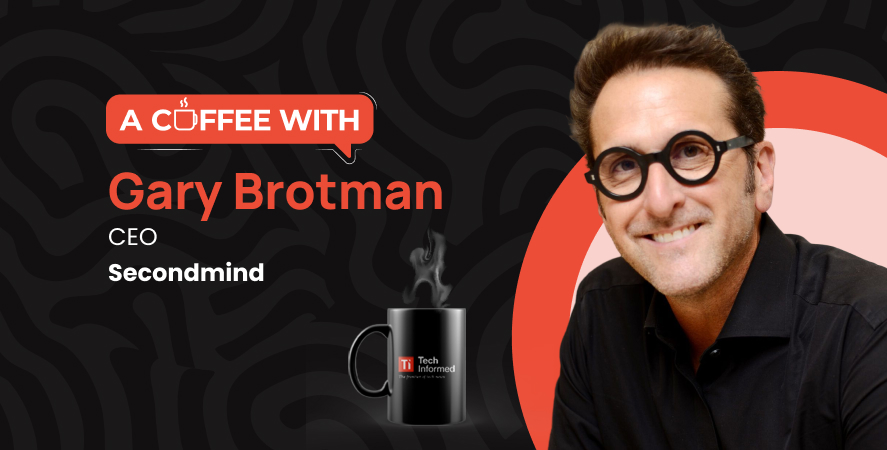
Secondmind’s CEO on building the engineer’s second brain
The Secondmind chief talks turning around a startup, swapping PR for technology and the buzz around ‘physical AI’
Before he was building AI for engineers, Gary Brotman was in PR — and before that, a club DJ.
Now CEO of Secondmind, Brotman relocated from the US to the UK in 2019, leaving a role leading AI strategy at Qualcomm to steer the company toward helping automotive engineers cut through data-heavy, guesswork-driven design processes. The idea is to build systems that learn from the sparse signal inside a large dataset rather than from sheer volume.
It’s a deliberate bet against the bigger-is-better logic of the large language model era, and one Brotman argues extends well beyond engineering, to any organization sitting on more data than insight.
Over coffee, he explains how that thinking helped him turn around a fragmented startup, why the hardest part of deploying AI is often just defining the problem and where he thinks the “physical AI” hype starts to break down.
When did you get into tech?
It was when my dad bought me my first Sony Walkman. I remember trying the demo in the store; it had the sound of a fighter jet flying overhead, with that 3D surround effect, and I actually ducked. I didn’t really get into computers until my late teens or early 20s, though. Before that, most of my interest was in music technology. I was a DJ, did some production, but I guess the Walkman was my first device.
How did the music experience transition into professional tech?
Actually, very well. I was a club and rave DJ for about five years during and after college. Then my wife and I moved from Dallas to Los Angeles, and I got a job at an international PR firm. After about six months, I had the opportunity to work with Creative Labs — one of the firm’s clients, and at the time the standard for PC sound, known for the Sound Blaster brand. In 1999, Creative Labs took the opportunity to OEM a Samsung MP3 player right as the MP3 format was taking off and everyone was starting to rip and share music. I was there for that launch, then built a digital music practice, which was the first of its kind in a major PR firm. Eventually, one of my clients hired me. So the thread running through it all was music, from DJing into the business world.
It’s interesting how you transitioned from PR into leading a tech company.
I think it comes back to two things — one being aligned with the mission of making the complex simple. That’s been my thing all along, and I’ve done it through storytelling. I also have a journalism background that helped with being skeptical and checking sources, but more than that, it gave me the craft of storytelling. Whether I was doing PR, e-commerce, product marketing or investor relations — it’s all storytelling. You’re building hope and showing people what’s possible.
Tell me about Secondmind and what you’re doing there with simulation and data.
Secondmind is currently focused on the automotive sector, though that’s really our beachhead market. When I took over the company, there was a lot of fragmentation and not enough focus. Coming from a product background, I always start with a problem — you need to validate that it’s real and repeatable, and that if you reach product-market fit, the customer will say “you’ll have to pry this out of my hands.”
We were originally focused on three industries, and automotive was where the results were clearest — specifically in engineering design and calibration. Our technology proved itself early with Mazda, helping calibrate the performance of their passenger vehicle engines. We projected around a 50% reduction in time spent in test environments with virtual engines; we’ve since proven closer to 60%. [Editor’s note: In addition to being a customer, Mazda has been an investor in Secondmind since 2023.]
The technology can calibrate motors, batteries, anything with a control system. Our active learning technology can talk directly to a motor or engine anywhere in the world via an API call, or to simulation tools like those from Siemens, Dassault or Ansys, running experiments in a data-efficient way. We then give engineers a clearly defined design space and a curated set of pre-validated designs so they can make trade-offs based on intuition and changing requirements, without having to run more simulations.
Fundamentally, it’s a parameter optimizer designed to help engineers discover better designs, or calibrate systems for better performance, than existing tools allow — and it’s all built around data efficiency. Everyone talks about big data and large language models today, but the reality is you can have a lot of data while the actual signal in it is sparse.
How data ready are your customers before they integrate the technology?
In automotive, there is a greater degree of data readiness. The bigger challenge is around defining the problem — what you actually want the system to do. It’s a bit like how we now prompt LLMs: we’ve never really had to explain what we want in natural language before. That’s part of our job — helping people get over that hurdle, because the old tools won’t get them there.
Eventually, all of this will move toward natural language, and a lot of it will be automated or agentic. One of our customers estimates 80% will be automated, and 20% will remain where human intuition, expertise and creativity live. That’s what Secondmind means: we’re building the engineer’s second mind, compressing the inefficient 80% so the remaining 20% gets the richest possible attention.
“Physical AI” was a bit of a buzzword earlier this year. What do you make of it?
I do align with it to some degree, because it captures technology that has to interact with the real world and understand its physics and geography, especially if it moves, like a car, robot or drone.
But the category is broadening so fast it’s becoming almost meaningless. I just read a 113-slide Deloitte report on it.
At some point, everything becomes “physical AI.” At the end of the day, it’s just new science aimed at efficiency. There’s no sentience, no machines taking over — because a human made the decision, not the algorithm.
How do you take your coffee?
Three shots of espresso, stevia and a spoonful of creatine.