
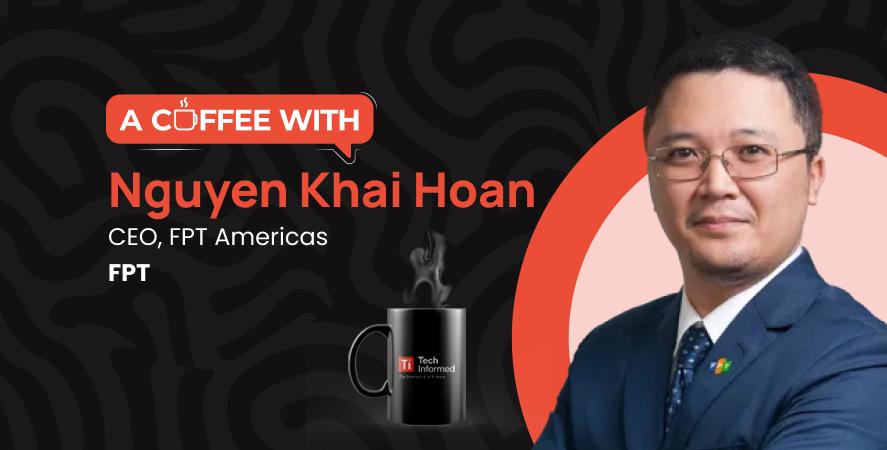
FPT Americas CEO on scaling AI from pilot to enterprise
FPT's new Americas CEO on why "time and effort" billing is giving way to outcome-based partnerships
During his 23 years at FPT Software, Hoan Nguyen has witnessed the Vietnamese IT services firm grow from a 100-person, $1 million-a-year operation in Hanoi into an 54,000-employee global business with more than $2.6 billion in revenue.
During his time, he’s held nearly every senior finance and operating role in the company, including chief accountant and CFO, and led six acquisitions, including a deal that he says made it the first Vietnamese software company to acquire businesses in both Europe and the Americas.
In 2026, he took on the title of CEO of FPT Americas, the North American arm of FPT Software. He relocated to Texas with his wife and three daughters to lead the company’s push into the US market.
Nguyen sat down with TechInformed for an exclusive discussion about why FPT is repositioning itself from a staff-augmentation vendor to an AI transformation partner; what that looks like in practice; and how he uses AI for everything from to running his own team to helping his daughters with their homework.
You have been at FPT for over 20 years; tell me about witnessing the growth within the firm.
When I joined, we had a team of roughly 100 people generating about US $1 million a year. I’ve been through many roles … Along the way I oversaw campus expansion. We managed the largest IT campuses in [Vietnam], and I also spent a year in Europe as managing director of a company we’d acquired. Over the years I led six different acquisitions, including the investment that made FPT the first Vietnamese software technology company to complete an acquisition in Europe and the Americas.
One of my greatest achievements is passing the $1 billion milestone with the company. Can you imagine, you start with the team generating $1 million, and I witnessed the first $100 million, the first half billion and the first billion dollars with the company.
When I joined the company, Vietnam was still an emerging technology market. Over the last two decades, both Vietnam and FPT have grown from a promising newcomer into a team of talent, building partnerships with leading organizations around the world. I feel fortunate for that.
How have emerging technologies helped FPT scale into a global company, and how has it changed what you offer customers?
For many years the IT-service industry was built around headcount and capacity … We built FPT University alongside FPT Software about 20 years ago, trained our students and provided expertise to our customers, measured largely by time, hours and effort delivered.
But today the model is changing. FPT has had to evolve from a traditional service provider into a transformation partner focused on business outcomes. Our role is no longer simply to respond to customer requirements … now we work alongside our customers to identify new opportunities.
Could you give some insight into the work you’ve been doing in the Americas?
AI adoption looks different from one industry to another. Today we’re working mostly with automotive, healthcare, manufacturing and insurance. They each have different reasons for embracing AI.
With automotive companies, AI usage is expanding beyond R&D and customer experience into production quality and supply chain management. With medical device companies, they’re accelerating AI adoption to improve diagnostics and production innovation. With manufacturers, it’s more about orchestrating operations — we’re seeing growing demand for smarter, adaptive manufacturing systems that respond to real-time conditions. And with insurance companies, we’re deploying AI at scale for real-time claims processing, fraud detection, risk assessment and so on.
Are there any specific customers you can tell us about?
We work with a large automotive service provider here in the US, helping drive digital and AI transformation. We began as an application support engagement seven years ago, and today we’ve evolved it into an AI transformation partnership. We scaled our team from almost zero to 1,300 professionals. Today we manage about 770 critical systems through an AI hub that integrates systems and solutions across the enterprise. Our work has helped reduce reporting time from several days to minutes, and we resolved tens of thousands of security issues within two months. Security is becoming so urgent and important with AI now, and we’re helping them accelerate the transition from small-scale pilots to enterprise-wide AI adoption.
We have another example in insurance. We work with a global provider of professional and technology services across the insurance value chain. The client wanted to build a cloud-native, AI-first claims platform while creating a more scalable software delivery model for expansion into Europe and North America. FPT embedded AI across the full software life cycle — from requirements analysis and technical design through to coding and project management. We helped them generate code five times faster and cut code review time in half. With the new model they can grow roughly twice as fast and increase their margin. It demonstrates how AI can improve not only engineering productivity but also speed to market and overall business performance.
How do you use AI in your daily life — not just at work, but personally too?
Nowadays you really can’t avoid AI. At work, I’m building my own AI assistant to help coordinate and streamline work, doing things more efficiently. At home, my family uses an AI agent to help coordinate schedules, organize vacation planning and manage reminders. It’s especially useful when you’re traveling internationally, which my daughters do a lot. They love traveling, and you want to stay connected with them.
I have three daughters, as I mentioned. They all enjoy using AI for learning. Besides Vietnamese and English, I encourage them to learn other languages — each of them is studying a different one: Korean, Japanese and the youngest is learning French. AI is becoming a valuable tutor and learning companion for them.
How do you have your coffee?
I drink coffee a lot, about six a day: espresso, no milk and no sugar. You may know Vietnam is the world’s second-largest coffee exporter, and there we drink very strong Robusta. After Vietnamese black coffee you can practically feel your heartbeat — it keeps you awake all day.