

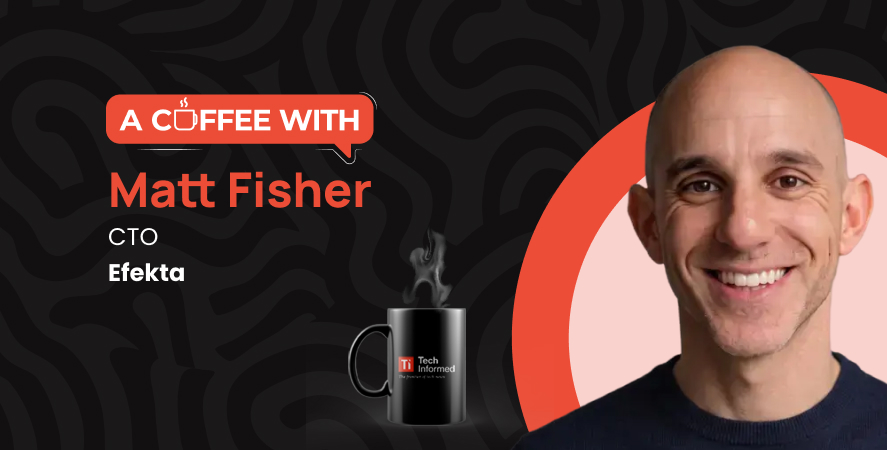
AI is turning the CTO into a CPO, too, says Efekta’s Matt Fisher
Efekta’s new CTO on the three jobs the role now carries — infrastructure, security and product — and why AI prototyping tools forced the change
According to Matt Fisher, the CTO job is starting to absorb a second role.
“Anyone can prototype something” now, says the newly appointed chief technology officer of Efekta, the AI teaching platform spun out of EF Education First. When the cost of building drops that far, he argues, the technical lead can longer hand the “what” and the “why” to someone else. The role has to become “closer to a hybrid of CPO and CTO.”
He has arrived at this conclusion drawn after a winding career. Fisher dropped out of law school three days before it started, taught himself to code at a Seattle startup, worked on Bing monetization and applied AI at Microsoft, and led measurement for Prime Video at Amazon, all before cofounding and serving as CTO of two startups, most recently as CTO of Stitch Fix veteran Julie Bornstein’s AI shopping company Daydream. In July, he joined London-based Efekta, whose platform reaches more than 4 million learners.
Over an iced water with lemon (he’s a Seattle native who doesn’t drink coffee), Fisher chatted with TechInformed about the merging of the CTO and CPO roles, hesitance about AI in classrooms and how he uses an AI agent as a stand-in for a career coach.
Tell me about your career leading up to where you are now.
I did my undergrad in law, or prelaw — I wanted to be a lawyer and wanted to work in the music industry. I got into law school here in Seattle, at the University of Washington, and dropped out three days before it started.
So I joined a startup in Seattle in 2008. I was employee number three or four, and I had to do everything: sales, building the website, business development. I’d never written code in a production capacity before that point, but it came naturally, and that set me on a path of self-teaching.
That eventually got me to Microsoft, where I started on the Bing search engine, working on the monetization side, before moving through Office, Windows and their developer outreach program. I then left for Amazon, where I led all of measurement for the Prime Video group.
I went back to Microsoft to lead a new team in Azure on applied AI, right as Microsoft and OpenAI began their relationship. At the same time, I did a master’s at Brown University focused on ethical AI. I loved the school so much that I’m now an adjunct there.
I eventually left Microsoft to start a company called Daydream, building AI-driven e-commerce for fashion, before cofounding Adventr, building tools for media creators with Netflix and Toyota among our clients.
Then I connected with the team at Efekta, and their mission resonated instantly, so I stepped away to join them.
Do you think the CTO role is changing?
Yes, the role is much heavier now.
In the past it was much more purely technical: build the services, the stack, the product, and let your other partners take it from there.
Now, because anyone can prototype something using tools like Claude or Codex, the CTO role has to be much more tightly integrated with product and business than before. [I think of it in three parts.]
First, infrastructure — making sure everything’s properly set up.
Second, security, which is becoming a much deeper part of how a CTO has to think. It was always part of the role, but now it’s more about enabling others to build at speed while staying compliant and secure.
Third, CTOs need to be far more tightly integrated with product and business than before — closer to a hybrid of CPO and CTO.
You have to know the customer and every angle of the business; in a startup you don’t have the luxury of handing something off to another team. Without tying together what you’re building, [as well as the] why and how, you end up with a lot of “AI slop” in the world, because people can build things and want to, without that clarity.
The CTO role is also becoming more of a strategic business [decision-maker]: which technologies to adopt, tying into finance as much as strategy. It’s historically been about your stack and languages; now it’s a much more holistic lens.
How are you translating that at Efekta?
I’ve spent my first month traveling to the different offices, meeting the engineering teams.
Data and infrastructure are really the only durable moats left. Everyone has access to similar models, but the training corpus is what matters.
I’m focused on how we use that securely and compliantly, both to inform what we build and to help learners in real time.
Have you seen hesitancy toward AI in education?
It’s rightful and justified for parents, educators and governments to be cautious about AI around young children.
That said, I haven’t personally encountered strong hesitancy. It’s less “we don’t want this,” and more “where do we want it?”
The main pushback is around security, privacy and making sure teachers stay central to the process. Teachers have eyes, a heart and ears in the room in a way AI simply doesn’t.
How have you used AI to help yourself grow and learn?
I have an orchestrator agent that sits on top of the tools I use daily, builds a memory of my conversations and gives me feedback on my writing, my code and my tone — a stand-in for a career coach.
I’m also using AI to learn an instrument and pick up new languages, since the more time I spend in Europe, the more I realize I need to diversify.
How do you have your coffee?
I’m strange, especially for someone from Seattle. I don’t drink coffee at all. I’m the outlier in a city where coffee is king. My father actually worked at Starbucks for about 16 or 17 years, and even he didn’t turn me on to it. I have iced water with lemon in the morning, and that’s it.
It helps that I do long-distance running, ultramarathons, so my heart rate is nice and low. But I also have three kids, so some days I wish I drank coffee, because it’s exhausting.
This interview has been edited for length and clarity.