

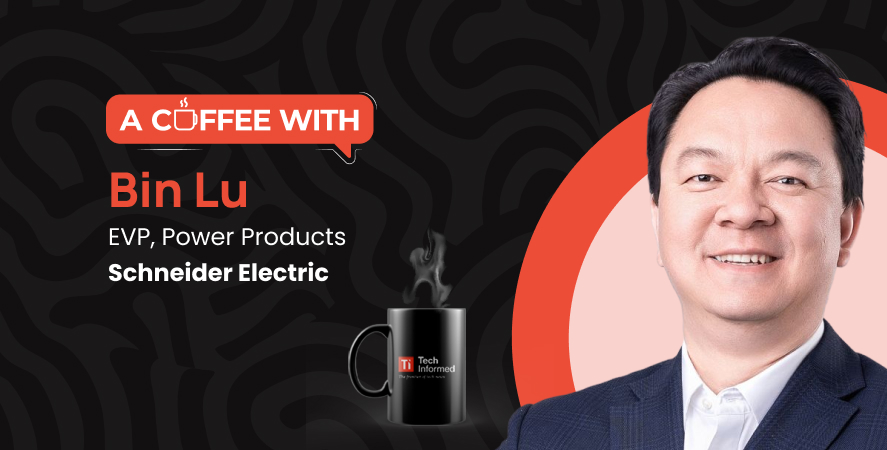
Bin Lu on why the US grid can’t keep up with AI
The Schneider Electric EVP on why the US grid is a bigger constraint on AI than China’s
AI’s appetite for power has made electricity the binding constraint on economic growth — ahead of money, technology or labor — says Bin Lu, executive vice president of Schneider Electric’s Power Products Division. And the strain isn’t evenly distributed: with no single national grid and transmission lines that predate the internet, the U.S. is finding new capacity far harder than China, pushing data center operators toward on-site generation and microgrids.
Over a coffee with TechInformed, Lu explains why AI is both the cause of the crunch and part of the fix, what “energy intelligence” means in a factory or hospital and why he now picks a lighter model for his personal ChatGPT queries.
Could you outline the issues AI is creating around power demand right now?
There are three megatrends shaping our lives today and into the future, and energy is the first of them.
A lot of energy demand is being driven by electrification — vehicles, buildings, data centers — which we see as a good thing, because electrification tends to be more efficient. But consumption patterns are also shifting fast. Data centers of all kinds, including AI facilities, currently account for less than 3% of energy consumption, but that share is climbing quickly.
It varies a lot by location: In Virginia, Data centers account for around 25% of statewide electricity demand in 2024, already the highest concentration in the United States. EPRI predicts the share to reach up to 57% by 2030, illustrating how concentrated AI infrastructure growth can fundamentally reshape a state’s power requirements. To address the ever-increasing data center electricity demand, Virginia is the largest net recipient of interstate electricity in the US, importing 36% of its total electricity supply in 2023.”
So you’ve got electrification and rising demand on one side, and data center growth driven by AI — large language models, agentic systems — accelerating that demand further. At the same time, the world isn’t getting less divided, so companies also have to figure out how to manage supply chains and technology in an increasingly multipolar environment.
Why should businesses and everyday people be concerned about rising AI-driven energy demand?
Because it touches everyone’s life. It’s hard to find someone today who isn’t relying on AI at some level, whether for work or leisure, so we need to keep supporting that technology responsibly.
But it’s worth remembering that data centers still represent a small amount of total energy use. There’s still your home, your grocery store, your hospital, your factory, your power plant — so we also have to keep driving efficiency and intelligence across that much larger, non–data center share of energy use.
You’ve said this isn’t just about generating more energy, it’s about making energy use more efficient. How can AI companies do that?
AI drives energy demand, but it’s also an enabler — a technology that can make energy systems themselves more intelligent. We call this “energy intelligence.” Think of a home: lights, phones, laptops, all kinds of electrical loads, historically controlled separately, with power flowing one way from the grid to the house. Now those devices increasingly talk to each other.
I think of energy intelligence as a three-layer architecture.
The base layer is the hardware itself: electrical loads, motors, motor-control systems, uninterruptible power supply (UPS) systems for data centers, circuit breakers big and small.
What’s changing is that this hardware is increasingly able to communicate, via Wi-Fi, Bluetooth or industrial protocols, generating data as it does.
The second layer applies AI to that data to turn it into actionable insight — not just “the light is on,” but the ability to dim it, automate it or set routines.
Apply that same logic to a hospital, a factory or a data center, and you can diagnose pending failures, manage power flow and drive efficiency and sustainability at scale.
What’s stopping companies from implementing that kind of energy intelligence today?
It requires a real shift in mindset — this isn’t as simple as adding a sensor to a light. You need a full system, not just a smarter component. That’s why we think in terms of applications — homes, commercial buildings, factories, data centers — rather than individual products.
Two things matter: First, hardware needs to become genuinely connectable. Second, you need that additional digital, intelligent layer.
AI is moving beyond chatbot-style tools and being embedded directly into products, so it’s becoming part of the decision-making loop rather than just assisting a human in the loop.
How should a company decide where to start?
Every company understands its own application and segment better than anyone else, so the starting point is always: what problem are you actually trying to solve? For a data center, energy efficiency might be the priority; saving 1% on efficiency can translate into real savings on cooling. For a hospital, it might be less about efficiency and more about uptime, because the priority is never losing power.
From there, you have to think about architecture, because it differs enormously by application. Then you bring in the AI needed to optimize toward whatever objective you’ve defined. My advice is to look at this not as a component-level decision but as an application-and-architecture-level one.
Are people doing enough to tackle increasing energy consumption used by data centers?
Not enough, in my view.
Every government, industry, company and individual needs to recognize the challenge ahead. I made a comment earlier this year that resonated with a lot of people: this may be the first time in human history that the primary constraint on economic growth isn’t money, technology or labor — it’s electricity. The real question is where the next roughly amount of electricity over the next 15 years is going to come from.
The situation varies significantly by country. I’ve spent my life between China and the U.S., and their challenges look very different. The U.S. faces a much bigger energy constraint than China does, even though China faces its own challenges around access to the latest chips due to geopolitical restrictions.
China has invested heavily in renewable energy over the past 20 years and is now the world’s largest country by installed base for wind, solar and battery energy storage, alongside significant investment in transmission infrastructure.
The U.S. picture is different: there’s no single national grid but a number of regional bodies managing power generation. And more than 70% of the national grid is considered old — over 30 years — rather than built on the latest technology. So finding new power generation capacity in the U.S. isn’t easy, and companies often wait years for grid approval on new projects.
This is pushing companies toward more innovative approaches — on-site power generation to reduce grid dependency, microgrid systems, battery storage behind the meter. If the grid can’t deliver more power quickly, companies are finding ways to generate it locally instead.
Do you use AI in a way that’s more energy-efficient or sustainable?
I’ve become quite dependent on it. I use Microsoft Copilot for work and ChatGPT Pro outside of work, though they run on similar underlying models. But you raise a good point: I have started being more deliberate about which model I use. Most of my work — competitive analysis, for example — needs a more complex model that does deeper reasoning. It takes longer, but the quality is better.
For personal tasks, I’ll go to lighter models. They’re faster, they use fewer tokens, so I pay less, and they use less energy behind the scenes.
How do you take your coffee?
It depends on the day and whether I’m traveling, but I’ll typically start with a black coffee — no fuss, quick, and it gives you the energy you need. It’s a bit like the work I do at Schneider: get the job done, with energy, and keep it straightforward.
This interview has been edited for length and clarity.