

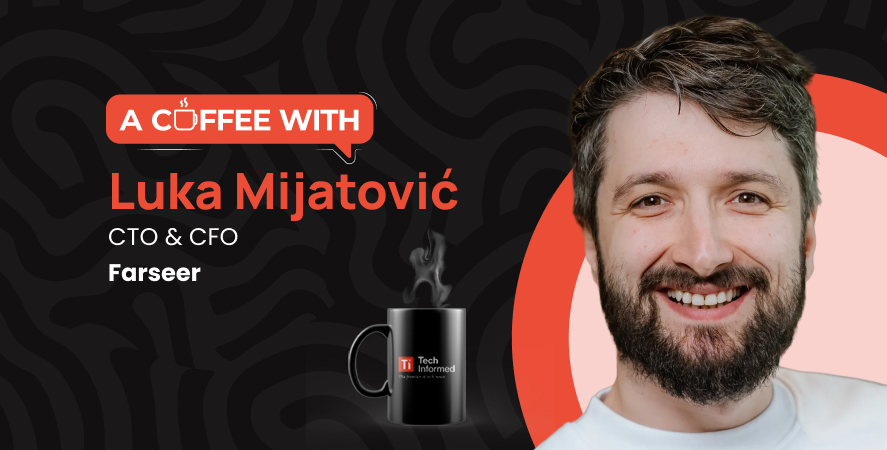
From dog ear filters to financial planning AI: Farseer’s CTO & CFO
Cofounder, CFO & CTO Luka Mijatovic on why scattered spreadsheets are blocking AI’s productivity gains in finance
Before launching financial planning software platform Farseer, Luka Mijatovic spent nearly five years as a 3D mobile engineer, building the face-filter tech you can find everywhere now.
“I went from putting dog ears on people’s faces to forecasting profit and loss,” he tells TechInformed over coffee.
After that, he and three cofounders, including now-CEO Matija Nakic, launched their platform to help finance teams keep planning, forecasting and reporting in one place instead of scattered across spreadsheets and disconnected tools.
The pair had discovered that many companies stuck to old-school spreadsheets even though dedicated tools had existed for decades: “we found they were fundamentally broken.”
So why were finance teams saying these tools were “broken”?
[Financial reporting and forecasting] tools have existed for a long time — every big company has their own version of one — and yet around 80% of companies still use spreadsheets for this critical finance process.
The key reason is adoption: those tools were quite bad. Many of the customers we spoke to over the years told us that even after implementing such a tool, they’d go back to Excel because it’s much easier to use and much more flexible. Those big tools can take a year or more to implement, and by the time you’re done, the business has changed — it’s much easier to just update your Excel sheet than go through implementation again. That was the biggest observation.
And now, with the rise of AI, this becomes an even bigger problem, because most companies still run their finances on spreadsheets or a bunch of disconnected tools, and AI can’t give you a good answer when the data is scattered everywhere.
So what we do is bring all your data definitions into one place — your planning, your workflow, all in one model — where everything recalculates automatically. We’ve invested heavily in building our own calculation engine and database, so even with millions of numbers, it updates instantly. That’s becoming an even bigger value for our customers as AI adoption grows.
With how unpredictable things have been globally, how does AI help businesses be more flexible?
AI has shown a huge increase in capability, especially in the last 12 months, and we all use it constantly — it’s great. But it hasn’t really translated into productivity gains in finance departments specifically.
People in finance help themselves with AI as much as they can, but it’s still mostly bottlenecked around manual spreadsheet processing. When you’ve got hundreds of spreadsheets, plus ERPs, data warehouses and everything else, AI can’t really help because the data isn’t centralized.
That’s the number one thing stopping the kind of productivity increases AI has brought to other professions; developers, for example, are far more productive than they were before. Finance still has a big barrier stopping it from getting those same promised productivity gains.
How can CFOs feel like they understand the output of an AI tool and back it confidently?
That’s always the first question we get from a CFO: can I trust these numbers? AI is great and it helps a lot, but for the foreseeable future, the top priority is getting the numbers right. That’s why we’ve focused so much effort on making sure our underlying engine doesn’t make numbers up. That’s what we can offer — the trust and the ability to trace every number back to its source and see exactly how it was calculated. That’s crucial for CFOs to be confident their numbers are right.
How are CFOs reacting to Farseer’s AI chatbot?
We have plenty of customers using our AI analyst, and what surprised us is that it allows C-suite people to interact with their finance department even when the finance team is asleep. One CFO told us that’s been a huge relief: the CEO always wants answers, always wants numbers, always wants to know “what happens if we do this or that” — and now AI can handle that, so people don’t have to be awake at night waiting for a message from the CEO.
Tell us about building the database and calculation engine from scratch.
We invested a lot of effort building our own. That’s not the typical approach — most companies license an existing component, commercial or open source. We deliberately built our own because we wanted it to be our competitive advantage, and we wanted to be able to tune the entire technology stack to the exact workload our customers need. That took years of deep-tech investment, and it was a risk — we didn’t know for certain it would pay off. But benchmarks later showed our engine is performing.
How do you take your coffee?
I like espresso, without sugar or milk.