
The 2026 World Cup will span three countries, feature 48 teams and draw a global audience expected to exceed 6 billion.
But the real challenge isn’t just delivering sport at that scale — it’s ensuring fans, players and officials all trust what they’re seeing.
Formula 1 confronts a version of the same question. Each race weekend generates hundreds of terabytes of data, all processed and distributed globally while the car tires are still hot. Long a testbed for high-performance computing and real-time analytics, the sport continues to push the boundaries of AI under extreme conditions.
Despite their differences, both sporting bodies have turned to artificial intelligence not as spectacle but as infrastructure — tools designed to make decisions more transparent, operations more predictable and outcomes more credible.
The Lampard problem
For FIFA, the turning point came in 2010.
“Until 2010, there was almost no technology directly integrated into the game itself,” says FIFA’s director of innovation, Johannes Holzmüller. “That changed after the famous incident at the 2010 World Cup in South Africa, when [England’s] Frank Lampard’s goal wasn’t awarded.”
England trailed Germany 2–1 in a knockout match when Lampard’s shot struck the crossbar and bounced down, landing more than a foot behind the goal line before spinning back out into play. The referee waved play on. Replays confirmed what millions of viewers had already seen — it was a goal — but the call stood, and England lost 4–1.

The moment exposed a gap between what referees could see and what billions of viewers saw replayed from multiple angles. If fans at home had better information than officials on the pitch, the legitimacy of decisions was at risk.
“These tools aren’t about technology for its own sake,” says Holzmüller. “They’re about fairness and experience for players, referees and fans.”
FIFA responded first with goal-line technology, then video assistant referee systems. More recently, the governing body has introduced optical tracking and AI-based analysis.
For the 2026 tournament, that effort extends to AI-generated digital avatars: realistic 3-D replicas of every player, built from precise physical measurements.
When a referee’s flag goes up for offside, fans in the stadium and watching at home will see a 3-D replay showing exactly where each player stood the moment the ball was played.
Art Hu, Chief Information Officer at Lenovo and Chief Technology and Delivery Officer of its Solutions and Services Group, said the goal is accuracy and realism rather than spectacle.
“No two footballers are the same, with the same physique or dimensions,” he said. “Each player’s exact dimensions will be taken into account, so decisions are supported by representations that reflect reality.”
The technology was trialed at the FIFA Intercontinental Cup in Qatar in December. Secretary General Mattias Grafström said AI-enabled 3D avatars “strengthen confidence in key decisions and bring fans closer to the process than ever before.”
Managing complexity at continental scale
The logistical demands of a 48-team World Cup spread across dozens of venues have pushed tournament operations into territory more familiar to global supply chains than sporting events.
To manage the complexity, FIFA will deploy an AI-powered command center to generate daily operational summaries and monitor activity across venues, transport, security and fan services in real time. Digital twins of stadiums and surrounding areas will support situational awareness, while AI-driven wayfinding will connect cities, fan zones and venues into a unified navigation layer.
“Data availability has changed everything.” says Holzmüller. “Fans, teams and players all have immediate access to information. With AI, you no longer need to be an expert to extract insight — you can just ask.”
The aim is to move from reactive operations to predictive oversight: identifying crowd flow problems, transport bottlenecks or security concerns before they escalate.
AI will also reshape the broadcast experience. Referee body cameras, first trialed at the FIFA Club World Cup 2025, will return with improved image quality and AI-based stabilization, offering broadcasters live streams from the referee’s point of view.
Formula 1: AI on the track
While FIFA grapples with geographic scale, Formula 1 operates at the limits of speed, latency and data density.
Each race weekend generates hundreds of terabytes of live data — from car telemetry and timing to video, audio and team communications — all of which must be captured, processed and distributed globally while the tires are still hot. The sport has used AI to automate tasks like color-correcting camera feeds, which is critical when lighting conditions shift constantly and up to nine cameras are mounted on each car.
The computational demands have driven a fundamental shift in how the sport operates. Before 2020, Formula 1 transported its entire broadcast and production infrastructure to each race. The pandemic forced a rapid rethink.
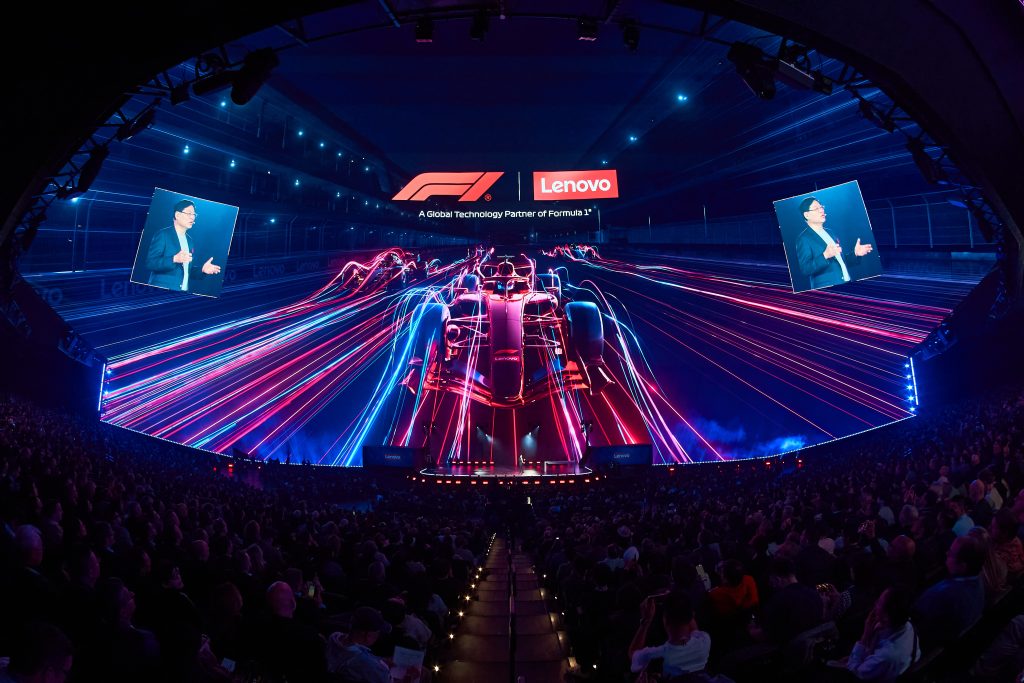
“Traditionally, we took the entire broadcast and production operation to each race,” explains Chris Roberts, director of IT at Formula 1. “In just ten weeks, we compressed around three years of work and delivered full remote operations.”
The shift halved the travel footprint. Only acquisition equipment now goes to races; production, graphics and direction are handled from the Media and Technology Center in Biggin Hill, outside London.
“That required huge faith in connectivity, latency, and reliability,” Roberts says, “but it worked.”
The change accelerated investment in on-premises computing. Over the winter of 2022–23, Formula 1 and Lenovo built a new data center in eight weeks, stripping out a warehouse and rebuilding it before the 2023 season.
“Those two moments really shifted how we operate and what’s possible,” Roberts says.
As data volumes grow and AI use increases, so has pressure on energy consumption. Formula 1 has committed to becoming net-zero by 2030, which requires balancing increased data processing against sustainability commitments.
To that end, the sport has adopted liquid cooling technology — systems that remove heat at the processor level using warm water instead of air conditioning — reducing cooling energy consumption by up to 40%, according to Lenovo, which developed the system.
For Roberts, liquid cooling was “a natural fit,” allowing more AI and data processing to run on premises without expanding the facility’s overall footprint.
The credibility equation
The thread connecting these efforts is not technology for its own sake, but technology in service of trust.
For FIFA, this means making officiating decisions legible to a global audience conditioned to second-guess what they see. For Formula 1, it means sustaining the precision that teams and viewers expect while meeting environmental commitments.