

Slalom’s ‘joy mapping’ fix for failed AI rollouts
Slalom's Sonali Fenner argues most AI rollouts fail because they sell efficiency, not agency, and shares the five-phase framework she uses instead
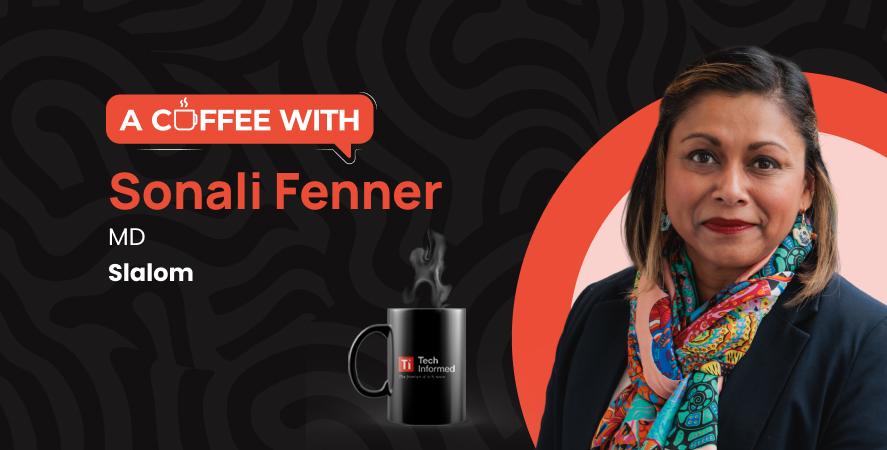
From biochemistry to hyperbaric physiology to corporate boardrooms, Sonali Fenner has spent her career mixing science and storytelling. Now, as managing director at Slalom, the global consulting firm, she’s applying that same human-centered thinking to getting AI adoption right.
Over a coffee with TechInformed, Fenner makes the case that most businesses have been asking the wrong question from the start. Specifically, they’ve been optimizing for efficiency when they should have been optimizing for purpose. She introduces her five-phase “joy mapping” framework, explains why top-down AI mandates are failing across industries and shares why she still insists her team write their own performance reviews.
Tell me about your career leading up to what you’re doing now.
I started with a BSc in biochemistry — I loved the discipline of it, the hypothesis, the evidence, having to rethink things when new evidence emerged. Then a master’s in aviation hyperbaric physiology, which is pretty niche, but fascinating: studying what happens to the human body in extreme environments.
From there, medical publishing, then Australia working in Rupert Murdoch’s venture capital arm, then agency and consulting — Ogilvy, Euro RSCG, JWT, Publicis Sapient. Eventually I reached a decision point. I didn’t just want to run something. I wanted to build something. That’s what brought me to Slalom, four years ago, and I still feel the same way.
I was thinking about it this morning just ahead of us meeting, and I was wondering what my red thread was. I think my red thread is design, because when you study physiology you learn that the human body is astonishingly good at adapting to extreme environments. But only if you design the environments around what the body actually needs. You don’t throw a pilot into a low-pressure cabin and tell them to cope; you design the pressurization system around their limits.
And I think across media, comms, consulting and business, that’s why, when we do things well, we talk about putting the human at the heart of everything. Whether that’s building a product, creating advertising or designing technology systems that people have to integrate with — that’s the core of it.
Where do you feel the master’s degree experience is becoming relevant with today’s technology landscape?
I’ve been talking to some of my team about AI adoption, humans and how we design systems. A couple of months ago, when all the stuff was happening around Artemis II, we were talking about the logic NASA used and the synergy there. They didn’t just hand a load of AI to the crew and say, “Get on with that.” They mapped very precisely where AI should sit around the jobs those humans needed to do, so that the crew could focus on what they needed to do, knowing the systems were running because they’d been designed that way.
Tell me about “joy mapping” in terms of implementing AI.
It comes down to five simple phases: listen, analyze, overlay, design and measure.
The first thing — and this seems to be what most people miss — is the listen bit. Before you deploy any AI, or even when an AI rollout has stalled and you can’t work out why, what we encourage customers to do is go in and talk to teams. Ask three questions: What part of the job drains you? Where do you need more time? What would you do with that time if you had it?
The critical part is that it’s a really positive conversation, not “what are you willing to give up?” You’re asking: what would you love to do more of in your job if all the tedious, repetitive, energy-sapping bits were handed off to something else? By doing that, you’re mapping where AI should sit so that the humans on your teams can do the work that gives them purpose. And arguably, that makes them far more likely to embrace the technology, because it’s doing the stuff they never wanted to do in the first place.
The second bit is the analyze phase, and you can run these in parallel. You overlay the human intelligence with analytical rigor.
We have a platform called EnhanceIQ. It takes a job description and analyzes it at task level. So if you said, “As a journalist, these are all the things I do,” it would take that and look at what AI can augment, what it can automate and what is innately human and should basically remain untouched.
Then in phase three, we overlay them: what the human intelligence told us and what the analytical intelligence told us. Step one gives you what people feel; step two gives you what the data shows. Together, they give you an AI strategy that the people you’re designing it for are more likely to embrace because they were part of designing it.
That then feeds into phase four, which is the design brief for implementation, co-created, with a clear view of what to automate first, what to augment carefully and what to protect. Going back to Artemis: that’s the equivalent of NASA designing AI into Orion so the technology handles trajectory and life support — things the crew don’t need to do so the crew could fly the mission, take the photos, do the live streams, run the scientific experiments that only they could do. You’re designing AI to handle the burden so people can focus on the things only they can do.
And then quite often this is where it stops, which is a mistake. There’s phase five: measure. Is it working? Are the areas you wanted to protect holding? Has the automation burden genuinely been removed, or has it been replaced by some other form of governance you hadn’t anticipated? Is the team spending more time on the high-meaning work they were excited about? Are people using the tool because they want to, rather than because they’re meant to? Are they coming up with new ideas faster? Are they engaged? That’s the full picture.
Why do you feel we need to address this now? Do you think businesses are expecting employees to pick up AI and run with it?
For the last two or three years, when generative AI first exploded, [the messaging] came top-down — from the board saying, “We need to be seen to be using this.” And when we looked at all the maturity curves, efficiency was the fast win. I think that’s eventuated into part of the problem.
We’ve been introducing AI to our workforces using the psychology of efficiency, when really we need to pivot to using the psychology of agency.
Almost every AI deployment over the last few years has been framed around the narrative of: this will make you faster, more productive, more efficient. Boards are talking about cost reduction.
The problem is that framing psychologically triggers people. When you say to someone, “This AI will make you more efficient,” what they hear is, “The way I currently do my job is too slow,” which leads to, “Maybe I’m not good enough.” If you deploy AI into someone’s workflow without talking to them, it reads as, “Someone else is telling me how to do my job; I’ve got no autonomy.” And if you talk about efficiency in terms of output that used to take days now taking seconds, the natural human instinct is, “The thing I’m really good at now takes a machine 10 seconds; what’s my role?”
Each of those individually is really negative from a purely human perspective. But all of that is happening at the same time. Companies are tending to deploy AI across multiple dimensions at once. The cumulative load of all of it means the rational thought, “Oh, that’s really good, what else can I do?” totally goes out of the window. That rational appreciation of benefit gets completely subsumed under the weight of it all.
And so what we’re getting is disengagement. All those engagement metrics are not real, because people are finding workarounds. It’s pure self-preservation: “I’m just not doing it.” And that’s why quite a lot of those initial AI deployments are failing. That’s why, when Harvard or MIT write their pieces saying most businesses deploying AI are getting zero actual benefit, it’s not surprising.
Do you think people are feeling under pressure to use AI where it’s not needed?
I think certainly in that first foray, specific tools were being pushed. It’s changing now. The reality is that in our day-to-day jobs, we use multiple tools at different parts of our work because they’re each good for different things. I’ll use Excel for this, Word for this, Claude for that, Chrome versus Edge for this or that.
Trying to get a single tool to be all-encompassing was also a source of rejection. People thought, “Well, I can do it better than that.” That’s starting to change, though. When we look at workflows now, the conversation is, “What are you doing here? You could use Claude for this bit, Codex for this bit, Copilot for this bit.” It all meshes together to create the workflow you need rather than a single mandated tool set.
It comes back to: what is the most useful thing to offload as a burden for the humans in this particular workflow? What tooling matters most for them? Then you ring-fence licenses around that. Which might be a different answer for someone in a different role. It goes back to understanding what is the most valuable thing for that person, with their unique workflow, in their unique situation.
How do you use AI in your own daily work?
I use it quite a lot, but very intentionally.
I have a bit of a bugbear: I don’t like to start with AI. A lot of what I do is consulting advisory. It’s experience-based. It’s advice on where a business needs to look in the next three, five, 10 years. If I start with AI, I worry that the output isn’t defensible, because it needs to come from all those building blocks I talked about.
So the way I tend to use it at work: I’ll put a point of view together first. I’ll use AI to crunch through numbers and give me analysis of something that might have taken my analysts or me two, three, four days, but I’ll always go through it, because there are nuances humans catch that the system might not. And in the end, the advice comes through me. I’ll use AI to challenge that, to challenge my point of view. Say: “If you were C-suite of X business and I was coming to you with this advice in this context, what would your arguments be? How do I need to shape this to be more compelling? Have I missed something?”
But I always start with my own point of view.
How do you take your coffee?
I worked with Starbucks for many years, so my coffee order at Starbucks is a grande skim milk coffee Frappuccino with three pumps of sugar-free vanilla.