
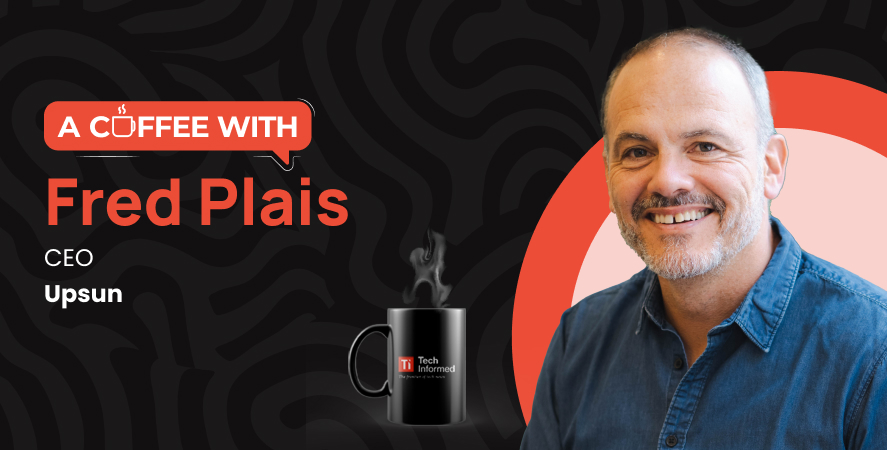
Upsun CEO Fred Plais on AI, green data centers, and early natural language search engines
Over coffee with TechInformed, the cloud platform CEO discusses AI-era infrastructure, greener data centers, and building a natural language search engine
In the early 2000s, Fred Plais built a French natural language search engine — a “taster of ChatGPT,” as he says, but without the AI. It didn’t survive Google. Now, as cofounder and CEO of cloud application platform Upsun, he’s watching artificial intelligence reshape software development from the other side: not in how code gets written, but in what happens after.
In this conversation, Fred reflects on a decade-long journey to build Upsun, a platform designed to make life easier for software engineers. He discusses how AI is reshaping software development, why infrastructure matters more than ever and how sustainability is built into the company’s architecture and culture.
What was your career like before Upsun?
I built my first company when I graduated, back in 1999, which was an extraordinary adventure. I was launching a search engine. Unfortunately, it wasn’t Google — and it didn’t survive the first internet bubble.
After that, I moved on and worked for various companies for about seven years before I had the opportunity to build another business, and then another one.
I would say Upsun is the most exciting company I’ve built so far. It’s been around for ten years already, we have very strong people on the team, we’re growing nicely, and we’ve raised a significant amount of money. The company is very sound — we’ve always been break-even — so we’re in a good situation.
What triggered the name change from Platform.sh to Upsun?
People often wonder why we’re changing the name now, because the company is successful and brand awareness is growing. The main motivation is what we actually do.
We are a cloud application platform. We help software engineers deploy their software to the cloud in a way that is very intuitive and fairly opinionated. Most things are automated: engineers don’t have much to do beyond clicking a few buttons or triggering a command to move their software from their laptop to the cloud and make it run properly.
Without a product like ours, companies have to build dedicated infrastructure teams, which is more complex, slower and comes with a lot of overhead. We provide speed and remove that overhead.
What’s changing today — and the real reason for the name change — is the rise of AI in coding. With ChatGPT and the incredible tools from companies like Cursor, Windsurf and GitHub Copilot, developers can move much faster and potentially write better code.
But while coding gets easier, the complexity moves downstream. You create new challenges around maintaining applications, deploying them efficiently on the cloud and managing security. So the complexity shifts to the platform layer.
We see a huge opportunity to support people building apps with AI features, and people writing code with the help of AI. That’s why we believe it’s time to rethink how the platform is built and how it operates, because it’s going to be used very differently.
That’s what we’re trying to communicate with the name change — a new picture of a platform designed for engineers who are leveraging AI in their everyday work.
What core values or principles will you keep? I know you were keen on sustainability
The cloud is not vaporous, as the name suggests. It’s very physical. We’re talking huge data centers that are bigger than hypermarkets. These servers inside are leveraging a ton of electricity, because servers are very energy-intensive.
We’ve built our platform to make better use of infrastructure. Most companies over-provision servers, running at around 20% capacity while using almost full power. We solve this by safely sharing infrastructure between customers, with strong isolation to avoid performance or security issues.
We also focus on where workloads run. A data center in Germany can emit around 600 g of CO₂ per kilowatt-hour, while Sweden or Canada can be closer to 20 g per kWh — a 30x difference, with no noticeable latency for users.
To encourage greener choices, we offer around a 3% discount when customers deploy in regions below 100 g of CO₂ per kWh, helping shift workloads to more energy-efficient locations.
Do customers ask for this, or is it more something you push?
The interesting paradox is that green is always more expensive. Usually, when you want something that takes care of the environment, you pay extra.
We don’t think that’s the way. We think it should be less expensive. So we agreed to take on our margin a little bit to make it cleaner.
It’s part of our goal and our culture, to preserve this idea of trying to preserve the environment and being as lean as possible.
Going back to the beginning of your career, your search engine Infoclic was really interesting. What did you learn from that?
Back in the time when we created Infoclic, the vision was inspired by Ask Jeeves. You would ask real-language questions and get answers.
It was like a taster of ChatGPT, but without AI or LLMs. It was crawling the web and matching questions to pages.
At that time, competition was AltaVista, Lycos — the first wave of the internet. The relevancy was very low. When I discovered Google’s ranking by popularity, I realized it was the right way to do it. I knew our approach was less powerful and the company would not survive Google. And that’s what happened.
What was it like for you seeing ChatGPT for the first time?
When I first discovered ChatGPT, I couldn’t sleep at night. I was completely blown away. It reminded me of that old project from 20 years ago.
We had the vision of how people would want to use the web, and now they found a way to make it incredibly efficient.
It’s not perfect, but it’s very impressive.
How do you switch off from work?
I get outside. I think many people in this industry spend way too much time in front of screens.
I try to exercise, run, get outside, get on water. I love doing that. I like kitesurfing.
How was the cultural shift for you, moving to the US from France?
It’s very different. It’s a great place to build a business. I love the speed, the ability of California to make very fast decisions and believe.
It doesn’t mean there’s no innovation in France, but it’s a different level.
My heart is still in Europe, and I’m grateful we have customers and employees in both Europe and the US. It lets me enjoy the best of both worlds.