Why AI pilots stall in marketing, according to Pencil’s COO
Marketing teams can’t get value from AI while it sits in a pilot, says Pencil COO Tobias Cummins. The limit is how much change the business can absorb
Tobias Cummins arrived in New York in 2017 with a team of four and a brief to build the U.S. arm of Byte, a London marketing technology agency. By the time he left in 2022, he says, the office had grown to about 80 people and Byte had been acquired by Dutch digital agency group DEPT.
A big lesson he carried back to Europe was about how much change a company can take in at once — what he calls a company’s “absorptive capacity.”
Now over a year and a half into his role as chief operating officer of Pencil, the AI marketing platform owned by The Brandtech Group, Cummins sees the same limit in the marketing departments of the large brands Pencil works with, among them Unilever and L’Oréal. The technology could “take off like a rocket ship,” he says. The organizations around it can’t.
Cummins grew up in Barbados, where he was friends with Pencil cofounder and CEO Will Hanschell. He began his career at a small London design shop and moved to the agency Iris before joining Byte, where he spent years on the Spotify account. After New York, he held senior roles at DEPT before joining Pencil in February 2025.
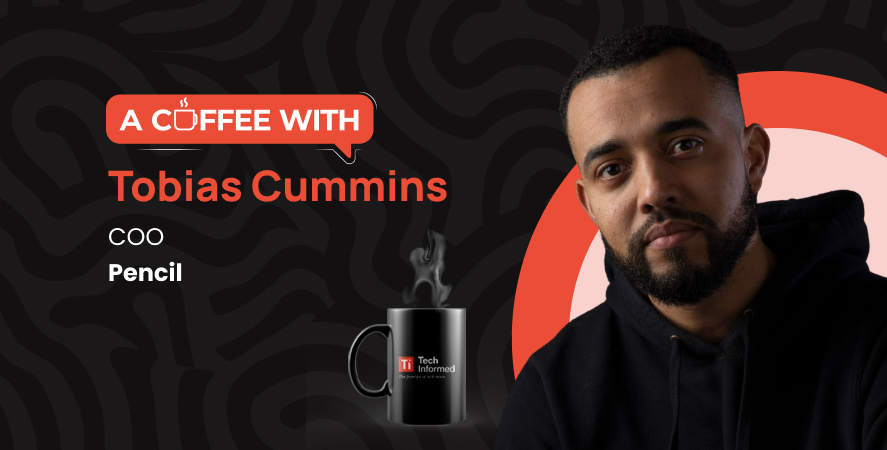
Over a coffee, Cummins explains to TechInformed what scaling a startup taught him, why AI pilots stall and how he talks with creatives who fear for their jobs.
Is there a formula that works in scaling a startup?
There are a few things I’ve learned over time. The old adage is that it’s about people. Some startups are really reliant on a founder or a leader, and for a period of time they need to be. The mission is very clear in that person’s mind, and if you’re around that person, you understand what it is. It’s crystallized: where you’re going, what you’re doing.
The job is to distill that into something many people can embrace. You need great people around you, and you need to start divesting that singular source of truth through a team. That’s the first typical step of a scaling business. You go from being in the minds of a couple of people to a leadership team that can drive the business forward and embody the same ethos.
I think talent density is important. Netflix has very clearly articulated this. Fewer, more talented people is far more impactful than many folks who are perhaps not as invested. It’s super important to maintain that density as you scale.
I’m a COO; I think clarity is immeasurably important. That means measurable objectives and key results. When you’re scaling from a startup, you tend to think about that secondarily. But beyond a certain point, it’s impossible to manage a business unless you can see what’s happening. Usually that’s a financial mechanism, or it’s … the productivity systems. Whatever you use, those become increasingly important as you scale. It’s not rocket science, frankly, but you need to know what step to take at what time.
I believe a lot in the absorptive capacity of a business. You can have a multitude of ideas, but your business’ ability to absorb those ideas is finite. So you have to engage with what you do, and when. The trick is not to slow down, but to understand where the business is at any given point in time. I work on two things: gating information so people can actually absorb it, and then increasing the business’ ability to handle more. It’s not about one or a few people moving fast. It’s about the whole thing moving fast.
That sounds quite similar to how people describe successful AI implementation. How is it playing out among the marketers you work with?
It’s like a Promethean moment: what are we going to do with this fire? You could do what you’ve been doing, or you can think about what you can now do.
Over the year and a half I’ve been at Pencil, that’s effectively been the journey most marketers have gone on. There’s this technology over here that’s quite interesting, so they put it in isolation to see what it can do. You’d create a presentation: “Look what it can do.” It’s quite performative. But now they’ve realized they can’t harness the power of the technology if they leave it in this little confinement, as a pilot or a sprint or whatever the case may be. They need to think about the implications for their legacy business.
That journey is nontrivial. It means unpacking all the inefficiency we’ve created over the years, in the absence of something that can all of a sudden think at pace, grasp context at pace and produce at a caliber and quality we haven’t had before. But it’s only as good as the people working with it.
There are things AI is incredible at, and there are things human beings are immeasurably incredible at. Creativity, for example, requires a point of view. AI doesn’t necessarily have one, but it can help you arrive at one that you then crystallize as a human being with perspective.
A lot of what we do is training on the platform and the executional side. But our more senior conversations with CMOs are about the implications of this technology for their business: how marketing teams are structured, how they structure their entire ecosystem with agencies. The conversation ends up being very strategically elevated, because the technology is a means to achieve a different type of organization in the future. That’s what marketers are interested in, at least the ones thinking about the future. If you’re not, it probably shouldn’t be on your agenda at this point.
How do you talk to CMOs, and to their creative teams, about working with AI?
Those two audiences are quite different. The designer, the creative or the practitioner is a very different thing from a business leader. The business leader has a fiduciary responsibility to their CEO or shareholders. They’re there to drive that agenda, and they see AI as a very lucrative means to achieve the results they’re responsible for. That’s a very different conversation from the one with a practitioner who is interested in their craft and the generation of ideas, and who, quite frankly, is also fearful of the existential question this poses to them.
That conversation is filled with empathy. It’s about understanding that there is a role for them in the future. Most of the friction with anything new comes from the fact that it feels at arm’s length from you. The more familiar you become with it, the more you see the flaws in it, the more you understand your role in combination with it and the more you see how it can make you better.
Closing that gap gets most craft people to a place where they go, “Ah, okay.” [It’s] a bit of a relief, frankly, combined with empowerment. But the more distant it is, the more cynical people tend to be. That’s the way I would frame it.
What separates the teams that succeed with AI from those that stall?
[Recently, I’ve seen] two very similar scenarios, between two clients. In one, there’s friction: they’re trying to find a way to leverage a piece of technology to get to an outcome, and the team says, “I can’t achieve this result because of the technology.” The same exact friction exists in a parallel context, but that team is more experimental. They see problems as challenges rather than obstacles, and they get right back to the outcome.
The real change is not the introduction of AI into the context. Yes, that’s the headline-grabbing theme, but the implication for us, and how we behave as a result, will be the thing we feel for years to come. I think that’s true not only for marketing but for everyone.
That’s the most interesting aspect of this. In theory, the technology is already so powerful that it could take off like a rocket ship immediately. I don’t think that’s going to happen. I think it’s going to move as fast as we move, not as fast as it moves. That has become so clear in the dynamics I work in every day.
How do you take your coffee?
Black. No milk, no sugar.
This interview has been edited for length and clarity.