
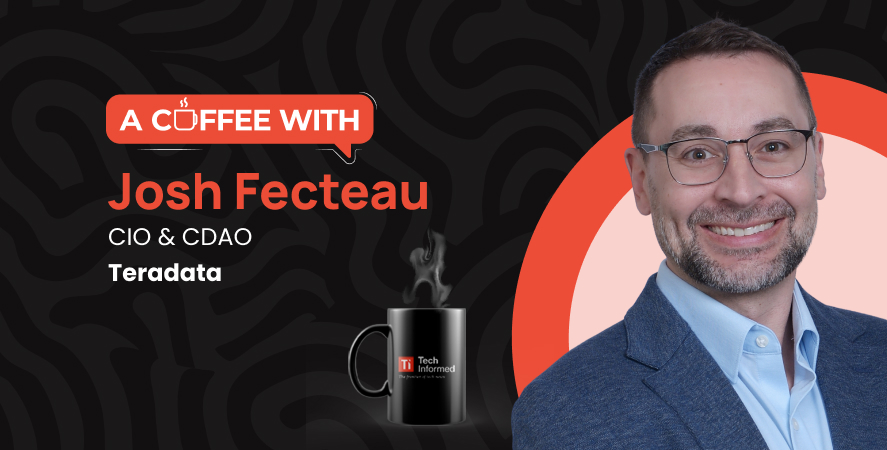
Why Teradata merged its chief information, data and AI officer roles
Josh Fecteau on why AI’s real payoff lies in governance and ‘temporal truth,’ not the models
As chief data and AI officer since late 2025, Josh Fecteau has recently taken on another title as CIO.
He says the role merger reflects the scale and speed of the shift across enterprise technology. It also puts the IT organization at Teradata, an autonomous AI knowledge platform headquartered in San Diego, at the heart of how it builds and governs AI internally.
Over a coffee, Fecteau talks with TechInformed about combining the two roles, why Teradata treats itself as customer zero and why he believes AI governance is where companies will see the most business value.
You’ve recently taken on a new role that combines CIO and chief data and AI officer. Why was that important?
As of late, I’ve become the CIO in addition to the chief data and AI officer. I’ve been CDAO for almost a year, and now my remit also includes technology services and the IT organization.
One of the things driving that necessity is the moment we’re in. This is a once-in-a-generation transformation as a result of artificial intelligence, and time is extremely compressed. Any gaps between road maps or departments are a negative. Bringing synergy and closing those gaps is really important to staying competitive.
Being a technology company that builds data and AI solutions, we have to move even faster. Bringing the IT organization into a more strategic position gives us a significant advantage because IT has reach across the company and can help bring AI and knowledge to employees through the technology they use every day.
Can you tell me about your background and how you got to where you are now?
My education is in information systems, technology, information management and telecommunications
I joined EMC as my first major corporate role. I spent the first half of my time there in IT and the second half on the business side. That gave me an understanding of how the technology worked, while also allowing me to drive business outcomes with that technical knowledge.
During that time, I worked on big data initiatives, proactive service and predictive maintenance using large telemetry datasets.
After EMC, I joined a consulting firm called CIO Sensei, helping CIOs and technology leaders guide cloud transformations and other major technology initiatives.
One of my clients was Teradata. I became very familiar with the company, its innovation and culture, and eventually joined as an employee.
One of the first programs I led was Transcend (an internal platform used to experiment with corporate data with the goal of optimizing products and services), which established Teradata as a modern data and analytics organization that used its own technology internally. That initiative has remained with me throughout my career at Teradata and has evolved into what is now our AI knowledge platform.
Why is that internal “customer zero” approach so important?
We depend heavily on our own Teradata ecosystem, and it’s becoming our autonomous AI knowledge platform to drive decisions.
Understanding how our own solutions work within our company gives us a much better understanding of how they should work for customers. We need our solutions to be useful for organizations, empowering decision-making, analytics and now AI and agentic solutions.
Many normal businesses now see themselves as technology companies. Are you seeing that with customers?
Yes, I think the SaaS era helped drive that shift. Prior to that, IT was a little more mysterious from a business perspective. It was a service people would depend on to provide certain capabilities, with applications hosted in data centres that were not fully understood by everyone at that time. And then SaaS made applications more accessible and demystified technology for business users.
For example, some applications available now have lower-code interfaces that people without technology backgrounds could interact with. At the same time, this also led to application sprawl, data sprawl and data drift. That complexity is now impacting companies’ ability to scale AI. Business users today have a much better understanding of how business applications work, and in many cases they’re the experts — not necessarily in the technology itself, but certainly in the data within it.
What challenges are organizations facing when trying to scale AI?
Historically, people understood the data within a specific application, but they often didn’t understand the broader business context.
That’s one of the biggest challenges with agentic AI. The same data may mean five different things in five different applications without the right context. Large language models will make assumptions if that context isn’t captured properly.
We’re helping companies contextualize their data, capture the knowledge that’s in people’s heads and build an autonomous foundation of knowledge that the whole enterprise can rely on.
What separates the companies getting this right?
We’re still seeing a gap between what people think AI can do, what executives expect it to do and what can actually be achieved.
Large language models are becoming commoditized. The real differentiator is a company’s own data, knowledge and workflows.
I’m a big believer in the idea of “temporal truth”: the truth at a specific point in time. Every business decision is based on the truth and context that exists at that exact moment.
Maintaining this evolving source of truth is difficult, but it’s essential if AI is going to make reliable decisions. That’s why we’ve focused heavily on enterprise governance and continuously maintaining that knowledge platform.
How do you maintain that source of truth?
Your data pipelines are part of it, but you also need a platform that can understand data wherever it exists, describe it consistently and bring it together with AI.
If you try to do that across thousands of disconnected systems, different metadata repositories and different definitions, it’s almost impossible.
That’s why governance is so important. It may sound like a boring word, but it’s foundational to building an agentic company.
Ultimately, what does success with AI look like?
The first thing AI does is unlock capacity by improving productivity. That’s valuable, but capacity alone isn’t enough.
The important question is how that capacity translates into business value. AI has to help increase revenue, improve margins or reduce operating costs. Otherwise, it won’t be seen as creating value.
That’s why we’re focused on identifying bottlenecks that prevent growth or efficiency and using AI to remove them. Capacity unlock is really just the means to a value unlock.
There’s a lot of discussion about AI replacing humans. What’s your view?
I actually have a different perspective.
I don’t think we should be trying to create AI that acts like humans. We already have humans.
We should be building agentic systems that eliminate unnecessary manual intervention and solve problems humans can’t solve. We should be creating systems that make better decisions, perhaps more ethically and more rationally than humans sometimes can.
The goal isn’t to replace people. It’s to free people up to do more interesting work while building systems that overcome the limitations humans naturally have.
How do you personally use AI?
I started with large language models like Claude and ChatGPT to help me understand large amounts of information quickly. They’re very good at taking lots of information and distilling it into something you can comprehend in a short amount of time.
I use AI constantly to help me understand complex topics, summarize information, restructure content into different formats and improve my own productivity.
I also rely heavily on our own internal knowledge platform. Across Teradata, people use AI in all kinds of ways — from forecasting revenue and managing operations to preparing presentations.
I use it for all of the above, while still bringing my own perspective and judgment to every decision.