

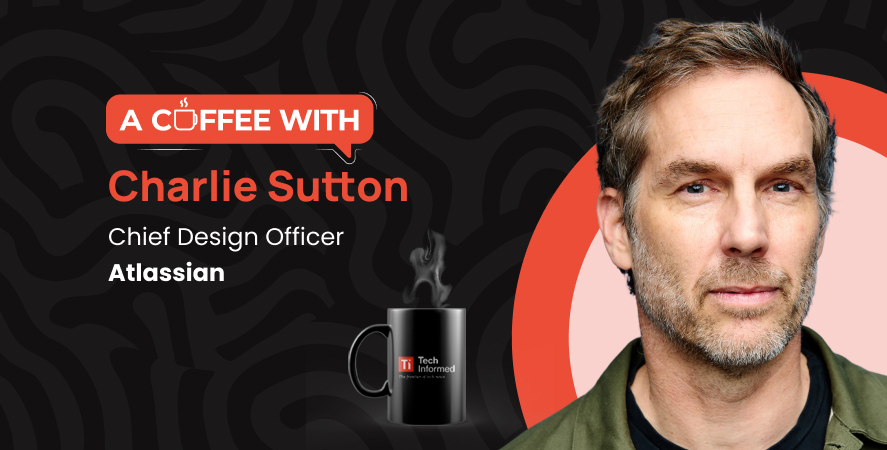
Atlassian design chief on making AI agents feel human
Charlie Sutton on long blacks, art history and why a softened hexagon changes how people feel about working alongside AI agents
Although it is a company with annual revenue of more than $6.5 billion, Atlassian is the smallest company Charlie Sutton has ever worked for.
Sutton, the company’s chief design officer, previously held design roles at Apple, Nokia, Samsung and Meta. He has always been interested in design, but he graduated with a dual degree in art and law before finding his footing in technology.
TechInformed caught up with him over a long black — not an Americano, as he’ll explain — shortly after Atlassian’s keynote announcements at Team ’26 Europe in Amsterdam. The conversation covered what art history can teach the AI era, why a detail as small as rounded corners can change human perception and how code has become a design material.
What have you learned about human psychology and design throughout your career?
Whenever you don’t know the answer to a question, look to art history. There’s almost a Peter Pan thing in the technology industry, where it’s all about the new. But humans have been struggling with these problems for a long time. Sometimes you’ll look at a painting, a sculpture or a Braun shaver from 1954, and all those lessons and ideas are there. From a design perspective, the past is very instructive, even though we’re dealing with agents and models today.
I do a fair bit of teaching design, and I always try to get across that design is a bouncing point between the familiar and the novel. The real art is finding the balance. Too novel, and people are disoriented and uncomfortable. Too familiar, and we’re not quite happy either. We do want things that surprise us and are new.
That’s a lot of what I do in my job, because we have customers who’ve been using our products for 23-plus years. Then you go to someone who’s maybe only ever used [another product]. Where’s their balance?
Why does it matter that technology be aesthetically pleasing?
We spend so much of our lives at work, and in the rest of our lives with technology, we’re used to little delightful touches. If we order a pizza now, we expect a pleasant confirmation. I don’t think we’re happy with things that are purely utilitarian. Color is very helpful for confirmation and communicating state, but genuinely, the little things you do repeatedly every day are where finesse matters.
The little moments matter a ton. We call them microinteractions: the small, subtle signs of confirmation, success or progress. A lot of the things we love in design or experiences are those types of ideas.
People have complicated feelings about AI. Where does design come in?
Any time a new technology comes into the world, it never comes as a pure thing. It comes with history, social ideas and other structures. So it’s important to remember that people need to feel comfortable and comprehend what’s happening, especially when something is new.
One detail is that we use a hexagon for agents. It used to be a really sharp hexagon. We wanted to say it’s not a person, it’s an agent. What we did was soften it. We call it the “squexagon.”
If you had a really sharp-edged hexagon with a picture of your face, it would almost clash. So we softened the shape to make it more approachable, because we’re always putting your face with the agent. We care about that relationship. It’s a tiny, tiny detail, but if you see it 100 times a day, it has an impact on how you think about things.
How does this compare with your previous roles at Apple and elsewhere? What do you bring from them?
It’s remarkably similar. At Nokia, for a lot of people, their entry into technology didn’t go through landlines. They jumped straight to a mobile phone, so they had none of the conventions. One of the classic ones was the phone-down icon, which is based on a landline. People didn’t know what that was because they hadn’t come through that.
What I’ve learned from those other big consumer companies is that when you get to tens of millions, hundreds of millions of people, you have to be very careful about making assumptions about how people think and feel. At Atlassian, you could have a small business in Paraguay or you could have Bosch, and you’re trying to find some commonality between them. That was very similar at places like Meta.
What does a surfer in Australia [gestures at himself] have in common with someone with a journalistic background from London [like Nicole, the journalist he’s addressing]? You try to find really common ground, because there’s no way you could please 3 billion people individually. It would be incoherent.
In design, we often call it trying to find the atomic idea, the thing underneath. A mate of mine who works at Apple said the atomic idea of the iPad is paper. We all know what paper is. You could go back 2,000 years, hand someone this rectangle you write on, and they’d say, “I get it.” You’re trying to look for those deeper things rather than just the technology on top.
Do you experiment with design in your spare time?
My history in design is more on the graphic design side, and I’m very nerdy for graphic design history, particularly non-Western graphic design. A lot of what we’re surrounded by comes from Swiss or European graphic design, but there are amazing traditions in places like Japan and Persia. I’ve been collecting graphic design influences from other places.
Persia, which is now multiple countries, has an incredible tradition of information graphics. I found Persian grain sellers who hand-drew charts of wheat sales per year, around 1903, and they’re so beautiful. They’ve got ideas I’ve never seen before because they’re from a different design tradition. For me, it’s pulling those ideas in, playing with them in code and messing around with them. A completely useless but fun thing.
How do you take your coffee?
Long black. It’s not an Americano. That’s the big difference. For me, it’s all about the crema. I learned this whole thing about mouthfeel: You get it from cheese and dairy, the feeling of fat. Anything fatty has a really pleasurable feeling. You pour the hot water first, then pour an espresso or two on top, so the fats in the coffee don’t get distributed through the water. That’s where you get that lovely mouthfeel in a long black.
This interview has been edited for clarity and length.